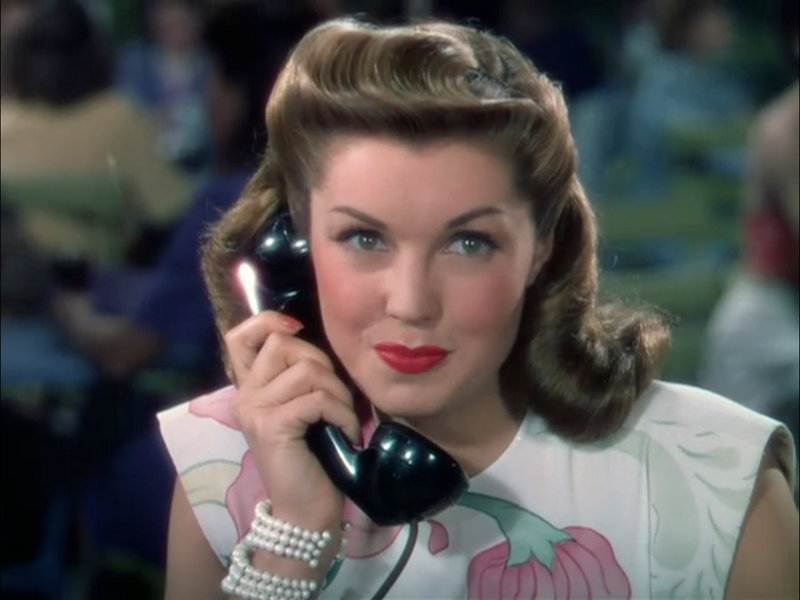
Double Life
This is the 12th excerpt from my biography of Esther Williams. You can find the other entries here. In the previous post, “Molding a Mermaid,” Esther underwent a rigorous “movie star training program” at MGM to prepare for her first onscreen appearance. In this section, Esther is slotted into the popular Andy Hardy series and deals with turmoil in her personal life.
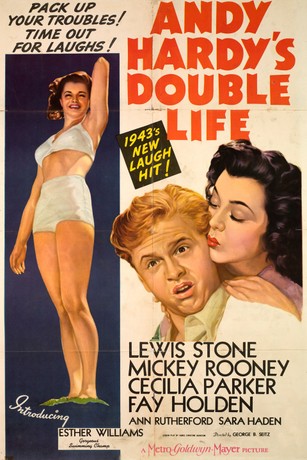
Andy Hardy’s Double Life
When Esther’s training period ended, she was cast in Andy Hardy’s Double Life (1942), the 13th installment in a series of films starring Mickey Rooney as the titular character. The Andy Hardy movies were wholesome family fare about teenaged Andy’s exploits and lessons learned. They were unflaggingly popular with audiences, which is why MGM kept churning them out, and they were also convenient tests for MGM’s starlets. The studio could slot their newest contract player into an Andy Hardy movie and see how audiences responded without risking too much money or time on untried talent. Previous films featured early appearances by Lana Turner, Kathryn Grayson, and Donna Reed, for example. If an actress did well, there was a good chance MGM would promote her to bigger roles. The studio decided Esther would be their next Andy Hardy experiment.
Production on Andy Hardy’s Last Fling (the title was changed to Double Life before it was released) began in June 1942. Esther played college girl Sheila Brooks, a friend of Polly (Ann Rutherford), Andy’s long-suffering girlfriend. Polly wants to test Andy’s fidelity, so she asks Sheila to tempt him into an indiscretion. The foolish young man is only too thrilled to fall into the trap.
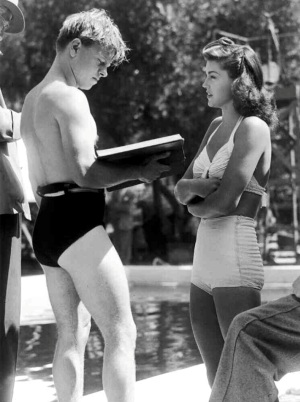
Esther’s big scene was filmed by a swimming pool on the backlot. She wore a white, two-piece, halter top bathing suit and she looked absolutely gorgeous—it was not difficult to believe that Andy would forget about Polly the moment he spotted Sheila. To his surprise, she kisses him, and he’s so overwhelmed he falls into the pool. This happens twice before they start chatting, and eventually Esther dives into the water. You can watch the trailer here.
Esther was understandably apprehensive about her first scene, but the director, George Seitz, was mostly concerned with camouflaging the six-inch height difference between Esther and Rooney. Seitz pulled her aside before they began filming and told her, “When Mickey stands, you sit. If you have to stand, bend your knees, lean down. Be short!” (Statuesque Esther would use these tips with other actors throughout her career, most famously Gene Kelly in 1949’s Take Me Out to the Ball Game.) Beyond that, Seitz had little to offer the novice actress, and she couldn’t relax until she dove into the pool.
The magic of editing makes the transition appear seamless, but actually the next sequence of underwater shots was filmed in the saucer tank on the backlot. The 5,250 square foot aboveground bowl had porthole windows that allowed cameras to capture the underwater action. (It was also where Weissmuller swam and wrestled rubber crocodiles in the Tarzan films.).
Once underwater, Esther felt and looked at home. “And of course I was,” she remembered, “I genuinely loved swimming and being underwater.” The shot of Esther frolicking beneath the surface was gorgeous and dreamlike: her mermaid-like ease and beauty “conveyed the sensation that being [underwater] was absolutely delicious.” This quality distinguished her water scenes throughout her career; indeed, when asked to name her favorite co-star, Esther answered simply, “the water.”

Andy soon follows Sheila into the pool, and the pair share an underwater kiss. It was lovely and sexy and show stopping. And MGM knew it. The publicity department began touting the scene and their swimming starlet months before the movie premiered. The Esther Williams-Mickey Rooney smooch inspired a rumination on the different types of onscreen kisses in Photoplay in October, and a Los Angeles Times article included four photos from the scene and an extended breakdown of how they captured the kiss.
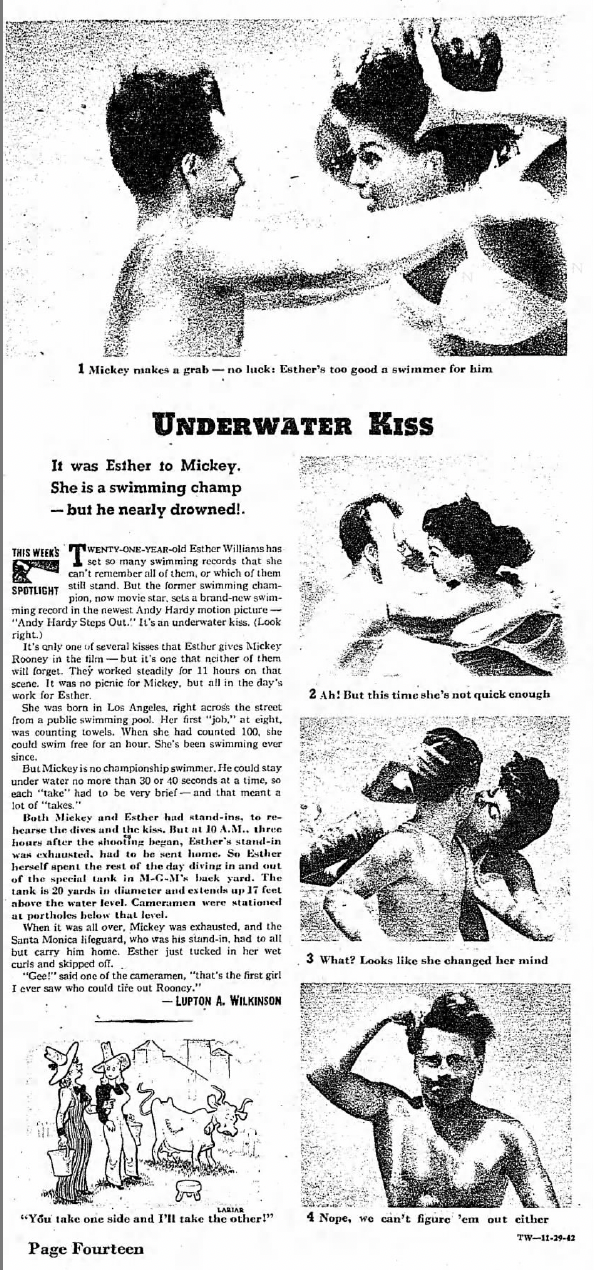
The article states that the pair “worked steadily for 11 hours…it was no picnic for Rooney, but all in the day’s work for Esther.” Both of the actors had stand-ins, as was typical, but
three hours after the shooting began, Esther’s stand-in was exhausted and had to be sent home. So Esther herself spent the rest of the day diving in an out of the special tank in MGM’s back yard…when it was all over, Mickey was exhausted, and the Santa Monica lifeguard, who was his stand-in, had to all but carry him home. Esther just tucked in her wet curls and skipped off. ‘Gee!’ said one of the cameramen, ‘that’s the first girl I ever saw who could tire out Rooney.’
*
When Double Life premiered in December 1942, Variety called it an “excellent audience pleaser,” and declared that:
Miss Williams, a swim champ in her own right, demonstrates in her film bow that she also is a looker by the same right and a capable actress to boot. Underwater scenes with Rooney in floundering pursuit of aqueous caresses are beautifully presented and filmed.
The Film Daily wrote, “The Williams girl, a newcomer to films, is an extremely photogenic type—sporting a stunning figure. Her talent is considerable, too.” Showmen’s Trade Review echoed the praise, calling it a “swell picture,” and noting that “…the series introduces Esther Williams, the swimming champ, who turns in a remarkable first performance as an actress and puts over a delightful and interesting water sequence. This young lady will bear some watching.” Columnist Paul Harrison commented on Esther’s beauty, writing that “In a couple of bits of pink bathing attire, she looks capable of luring a whole fleet onto a reef, so imagine what she can do to the Mickey Rooney-Ann Rutherford romance.”
Motion Picture Herald also assured their readers of Esther’s beauty, calling her “a swimmer of some renown” who “cuts a beautiful figure, especially in a bathing suit.” Variety was taken with her, too, naming Esther, whom they called “decorative and talented,” one of their “New Faces of 1943.” And it surprised no one when a group of sailors named Esther “The Girl We’d Most Like to Spend a Minute Underwater With.”
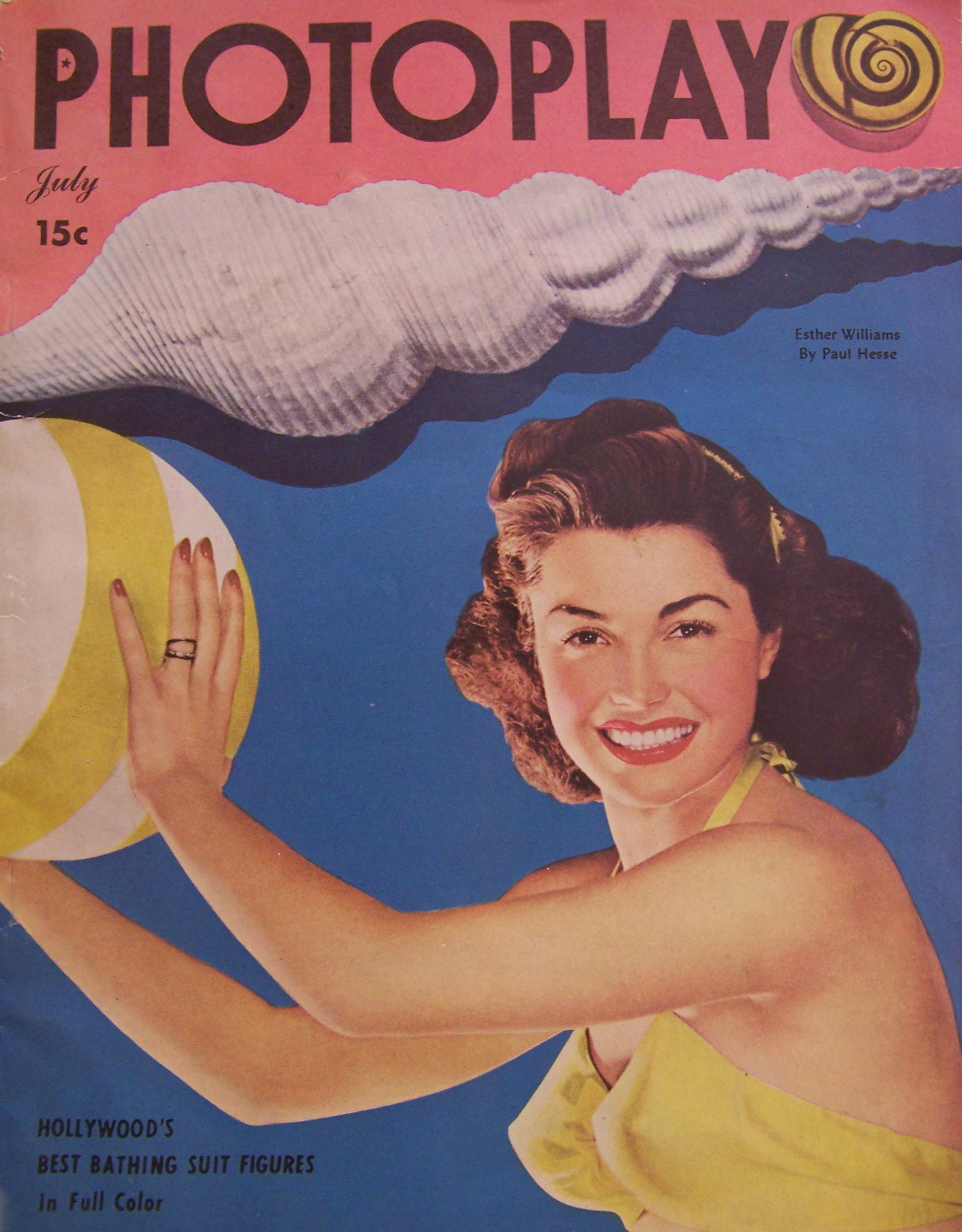
The publicity department roared into a higher gear when Double Life premiered. Reviews of the film detoured into Esther’s biography, and profiles in fan magazines and newspapers popped up more frequently. The same studio-sanctioned stories appear in Hedda Hopper and Lowell Parsons’ nationally syndicated columns, and echo from the pages of Photoplay, Screenland, Hollywood, Modern Screen, and any number of similar tabloids.
Most followed the template MGM had already set in the run-up to Double Life: Esther was a swim champ, a gorgeous All-American gal, and a reluctant starlet. Adorable anecdotes of a young Esther counting towels at the pool (for every 100 towels counted she got an hour of free swimming), and the lifeguards who “taught her the basic precepts of being a porpoise,” transition into her record-setting career and Olympic dreams. Nearly all the articles mention Esther’s astonishing unwillingness to sign a contract with MGM, and detail the studio’s efforts to bring her into the fold.
These early biographies and gushing fan-magazine features set the star image for Esther quite successfully: she was a healthy, sensible, All-American girl and star athlete who reluctantly traded in her “normal” life for movie stardom. She was confident but humble, hard-working and driven, but still a traditional girl at heart, and her best friend was her mother. A Modern Screen biography summed it up quite nicely: “Her belief in herself is the keynote of Esther Williams’ existence today and it’s the story behind the success story of a very normal, average American girl.” Hers was a twist on the normal story of fame-hungry girls or precocious youngsters with big voices or fancy feet knocking on Hollywood’s door, and put Esther slightly outside of the “typical” starlet box.
Adding to this “accidental star” thread of her persona was Esther’s dim view of her acting talents. She confessed that she couldn’t act but promised to try her best, and unfortunately this admission got wide play in the papers and stuck to her for years. Variations on the headline “Admits She Can’t Act, But Is Star” and “‘I can’t act—I’m a swimmer,’ she insisted” appeared nationwide in newspapers and fan magazines in 1942 and beyond. One might be surprised that such an insecure, unflattering comment got past MGM’s publicity agents, but it did fit into their carefully crafted narrative of Esther as a normal girl who didn’t struggle for nor particularly desire fame, which is why MGM had to chase her for so long. Her stardom was both accidental and pre-ordained: Hollywood glory was inevitable thanks to Esther’s beauty and charisma–whether she liked it or not!
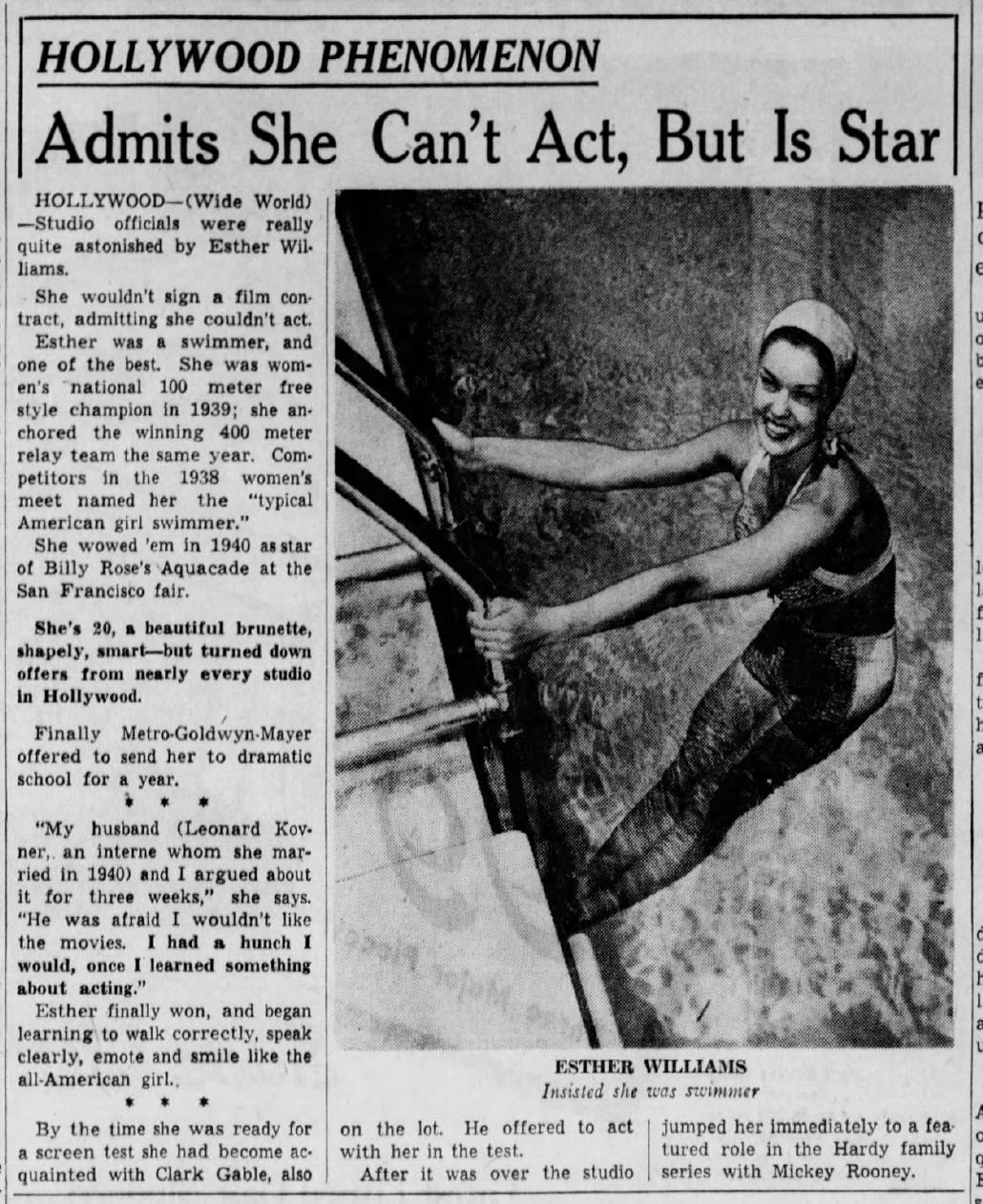
Esther herself regretted her unflattering confession about her acting ability, and disliked how frequently it popped up even decades later. She had worked hard to improve and become a good actress, so to have this silly, self-deprecating remark from the very beginning of her career constantly called back was unfair. As she wrote in her autobiography, “It’s one of the few things I’ve ever said about myself that I’d really like to take back.”
*
Another constant (and perhaps regrettable) theme in these early articles is Esther’s “perfect marriage.” She and Leonard are frequently called “childhood sweethearts” (even though they met at Los Angeles City College just months before marrying), and articles claim that their relationship is fairy-tale-perfect. For example, Esther gushed over their marriage to Hollywood Magazine in December of 1942:
‘Leonard and I have wonderful times together,’ she says happily, with a love-still-in-bloom expression. ‘We golf and ride and bowl together, and we have everything in common, except one thing. He refuses pointblank to go swimming with me. Now I ask you!’
But articles consistently state that Leonard didn’t want Esther to go into movies. In the summer of 1943, for instance, the gossip columnist Erskine Johnson wrote that Leonard “would be much happier if Mrs. Kovner was not a film actress.” He also claimed that Esther’s training period at MGM was Leonard’s idea, and included this rather dismal quote from Esther, “I guess he secretly hoped I wouldn’t survive that year.” But the articles generally include the happy news that Leonard eventually accepted his wife’s career. Quotes like this from Esther are common: “He says it keeps me amused and out of trouble. But he’s a typical husband: he wants me home when he’s home.” And of course she is a typical wife despite her day job. She “wakes up at six to make his breakfast and prepare a lunch for him,” and they live “in an unfashionable section of Los Angeles because it is near his hospital.” After all, Esther’s main priority was remaining a devoted wife with a perfect marriage.
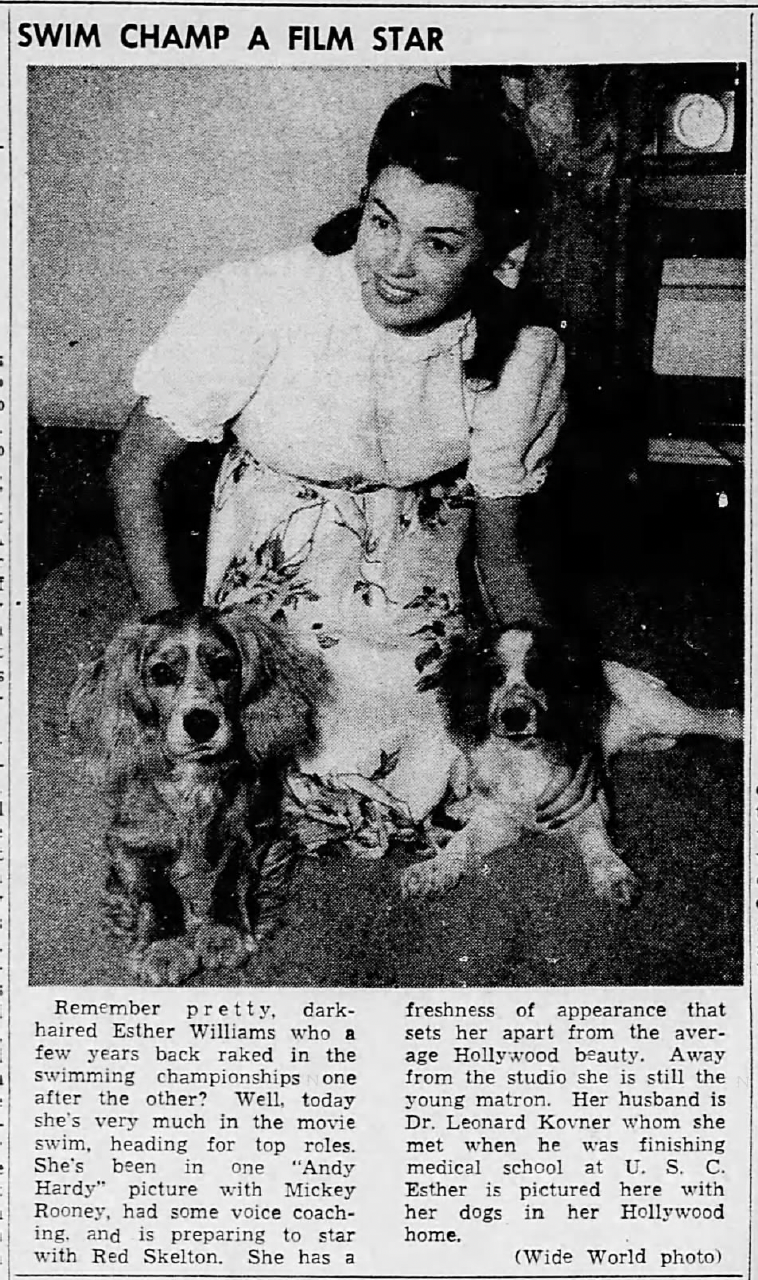
But that last part was all Howard Strickling-approved hogwash spun by the publicity department. According to Esther, her marriage effectively ended when she told Leonard that she wanted to sign with MGM. Their marriage was already faltering, and Leonard really, really didn’t want Esther to be in show business. When she told him that she had decided to accept MGM’s offer the morning after her tour of the studio, he lost it and chased her through the neighborhood. She took refuge with her landlady, and as soon as he went to work she grabbed her things and fled. She moved in with her parents until she got her own apartment. Any guilt she felt over her career’s effect on the relationship evaporated when she found out that Leonard had been having an affair during most of their marriage.
Although Esther and Leonard’s marriage unofficially ended in 1941, news of their “rift” didn’t hit the papers until three years later as Bathing Beauty neared release. Until the separation became public, MGM crafted an alternate reality for Esther in the press. She recalled later that “MGM didn’t have to concoct any stories. They simply took what was available and redefined it. My small house in Silver Lake turned into the ‘cozy cottage.’ My absent husband became the ‘hard-working medical student.’” MGM’s power to spin the truth is evident in stories like this one from February 1944: Hedda Hopper wrote in her column that Leonard was “too tired” to attend a sneak preview screening of Bathing Beauty. Hopper claimed his absence was due to a busy work schedule at the hospital, but that wasn’t quite true…
The divorce finally hit the papers in the summer of 1944. Ironically, Variety first reported Esther’s bad personal news just a few lines below the excellent professional news that she “planted her footprints in Sid Grauman’s Floor of Fame”! In those days, this honor was often granted very early in one’s career.
At the divorce hearing in September, Esther pled “mental cruelty” as her reason for dissolving the marriage. She testified that Leonard “maintained an attitude of criticism and scorn” towards her, and treated her, and her friends, with “superiority and contempt.” But what really sealed the deal was her claim that Leonard refused to have children. Esther’s mother supported her assertion, testifying that she heard Leonard say, “There wouldn’t be another Williams kid in the world if I can help it.” The judge granted the divorce in September 1944.
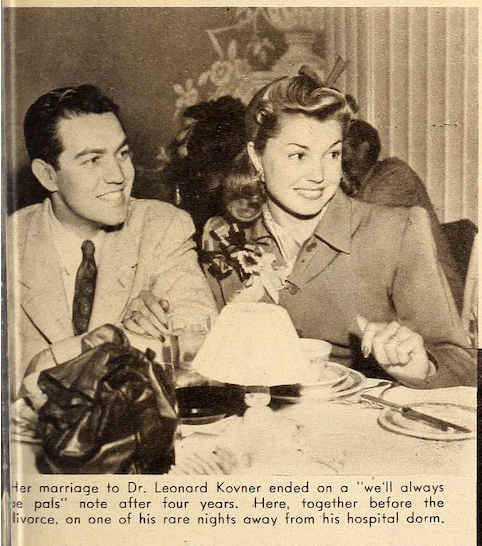
But even a few years later, the ugly relationship was brightened up slightly for the public: an article in Photoplay claimed that “To those of us who watched her she had the air of earnestly working at a task that confused her. Dr. Kovner was intelligent and very charming, but the fundamental incompatibility between them was quite obvious.”
The fan magazine Modern Screen took it even further in a cover story in 1946: the caption of a photo of Esther with Leonard read, “Her marriage to Dr. Leonard Kovner ended on a ‘we’ll always be pals’ note.” This despite the “mental cruelty” charge that was widely reported at the time. But such inconvenient acrimony was hardly an obstacle for MGM’s press agents.
Thanks for reading, and stay tuned for the next excerpt of The Mermaid and Me!
Categories: History
 The Blonde at the Film