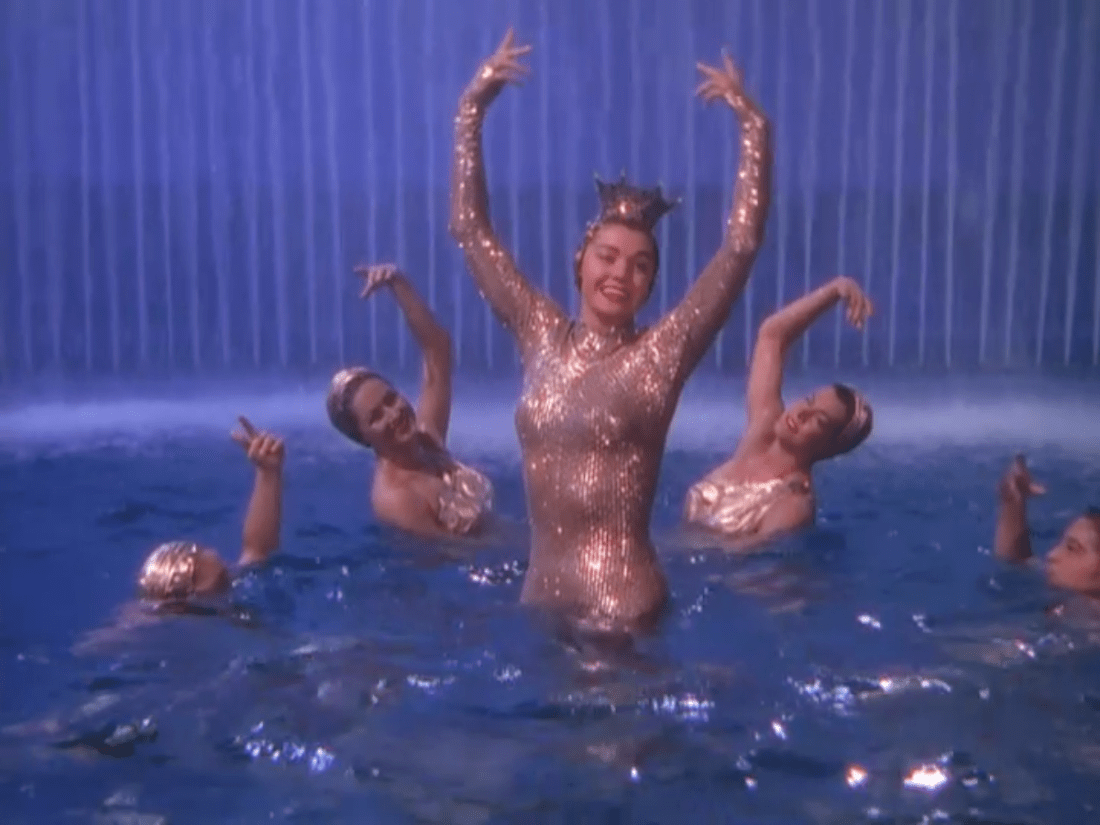
Most Perfect Mermaid
This is the 4th excerpt from my biography of Esther Williams, The Mermaid and Me. You can find the other entries here.
Esther Williams hoped to attend the University of Southern California on a swimming scholarship to continue her training and reach the Olympics. But she flunked algebra her senior year of high school, which kept her from graduating in the spring of 1939. (A few years later, when Esther was a movie star, an article in Modern Screen quoted Esther’s teacher: “If I was grading Esther on personality she’d get an A-plus. But unfortunately the course is algebra.”) Esther re-took the class at Los Angeles City College during the summer of 1939 and kept swimming.
Over four days at the end of July 1939, Esther competed at the National Championships in Des Moines and helped the L.A.A.C. to a resounding victory. Her club went home with 36 points, with Multnomah Athletic Club in Portland coming in second with 28. Esther won plenty of individual prizes, too: the seventeen-year-old took home three gold medals: one for the 100-meter freestyle, one for the 4 x 100-meter relay, and one for the 300-meter medley relay.
Her 4 x 100 relay squad, with Esther swimming the anchor leg, set a national record with their swim on July 28, and two days later, they set another record in the 300-meter relay. In fact, Esther, Motridge and Hopkins actually broke the national record twice in one day, first in their preliminary heat and then in the finals. Esther swam so fast with her butterfly stroke that she shattered previous individual records, though her time didn’t count since it was in a relay. But her “unofficial” one-minute, 24.6 second breaststroke leg was a staggering 2.5 seconds under the American 100-meter record, which had been set in 1933. Her team won the relay by almost an entire pool-length. She was a star.
A Beautiful Girl Athlete
When Esther’s elite swimming career took off, she began getting attention for more than prowess in the pool. As one can imagine, pretty young swimmers made for pretty pictures and popular features, and photos of Esther and her peers appeared in sports pages and magazines across the country. But even among the other fresh-faced “mermaids,” Esther stuck out as a stunningly gorgeous girl. A fan magazine recalled a few years later that “Whenever she put on a swim suit in public a news camera clicked. Esther Williams was what sports picture grabbers prayed for—a beautiful girl athlete.”
After all, her skinny, tomboy days were long gone by this point. She was tall, standing five feet eight inches, and she had grown into a strong and lean young woman, thanks to her hours in the water. But she also possessed sweater-girl curves, killer legs, and a movie star smile. As a fan magazine would write a few years later, “women drool with envy when they see her figure, men just drool.”

Esther garnered attention for her looks even before she was winning races. She was named the “Venus” of the Senior National AAU swim meet in Santa Barbara in July 1938, and she also was voted the “most perfect mermaid” at the event, based on her “style, her figure, height, and her beauty.” (All these accolades despite the fact that she came in third in her event.) An article published in January 1939 in the Los Angeles Times had the headline, “One Very Good Reason for Going Swimming” above a huge picture of Esther in a bathing suit. The article mentions her talented teammates, too, some of whom were already national champions, record-holders, and Olympians. Next to their impressive accolades, Esther was given the somewhat anti-climactic title of “free-style runner-up.” Another photo of Esther published a few days later used the more nebulous title “free-style flash” since she hadn’t actually won any big-time titles yet. But she was always included in the photos!
Her beauty was difficult to ignore, and midcentury chauvinistic standards let comments fly. For instance, Esther was described as “one of the prettiest performers ever to wear the Los Angeles Athletic Club emblem” with a “pleasing personality and a gracious smile.” And a photograph of the teenager smiling in a bathing suit (always a bathing suit!) published a few days before the 1939 National Championships had the caption, “What’s More, She’s an Excellent Swimmer.”

These pictures of Esther and her teammates verge on cheesecake and appear with copy that seems laughable today. The photographs were captioned with gems such as “bevy of bathing beauties;” “Lithesome Lassies,” and “Sitting Pretty: Here’s one reason why swimming is such a popular sport…Incidentally, the girls are star performers.” Even when the Los Angeles Times reported on Esther, Motridge, and Hopkins breaking the 300-meter medley relay record at the National Championships, they emphasized the beauty of the three swimmers, writing that the record “went down twice today under the onslaught of a trio of ‘easy on the eyes’ swimmers from the Los Angeles Athletic Team.”
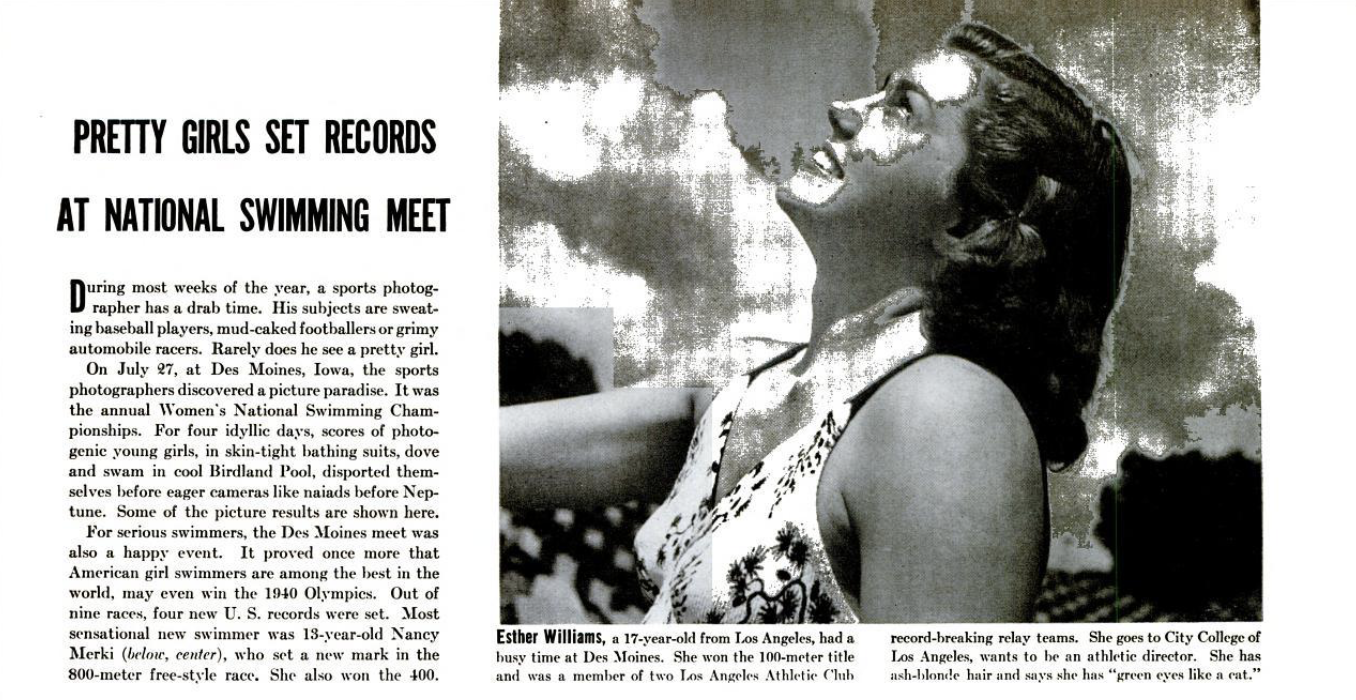
LIFE magazine’s article on the 1939 National Championships was no better. It featured photos of Esther and her competitors with the headline “Pretty Girls Set Records at National Swimming Meet.” The article is even worse than its sexist title, as it focuses on the pleasure sports photographers found at the swim meet: “For four idyllic days, scores of photogenic young girls, in skin-tight bathing suits, dove and swam in cool Birdland Pool, disported themselves before eager cameras like naiads before Neptune.” They were actually there to win races, not “disport themselves” for the cameras, but sure.
The photograph of Esther in LIFE shows her in profile, her eyes sparkling as she smiles up at the sky. The caption lists her accomplishments at the championship meet and notes that she has “ash-blonde hair and says she has ‘green eyes like a cat.’” As Esther later said, “newspapers loved pinup pictures of pretty young swimmers, and as a national champion, I got more than my share of space in the sports pages.”
But one wonders how different her life might have been if she hadn’t been so photogenic…
Hollywood Comes Calling
After all of this exposure in the sports pages and especially the LIFE article, it wasn’t long before the beautiful young swimmer caught the attention of Hollywood. The first “insider” to notice was a talent scout and lawyer named Roger Marchetti. He knew Aileen Allen, Esther’s coach at the L.A.A.C., who encouraged Esther to sign up as his client. She did, and Marchetti arranged a screen test at 20th Century Fox.
Esther had never taken an acting class and had no idea what to do. Unfortunately, the drama coach at Fox in charge of the test didn’t help. Esther remembers that he reeked of booze, and he certainly didn’t seem invested in her career potential. He didn’t give the nervous teenager much advice, and he didn’t involve the makeup or costume departments. Esther had to make do on her own without any movie magic. (It would be a very different experience when she tested at MGM a few years later.)
Esther wore a dress made by her sister Maurine, who by 1939 was a mother of two who occasionally earned extra money sewing clothes on the side. The Mermaid did the best she could opposite up-and-coming actor George Montgomery, but she had no illusions about her performance. She never saw the test, but when she met with the head of the casting department a week later (she arrived quite unglamorously on crutches because she had cut her foot at the beach a few days before), he told her “You’re a swimmer, right? Get back in the pool…Rethink your future. It doesn’t include movies.” Esther couldn’t know that he was ridiculously wrong, so his dismissal was enough to convince her that she wasn’t suited for show business. Since it wasn’t something she’d been planning on anyway, it wasn’t too hard to let it go.
Besides, she still had races to win! Esther continued her extraordinary performance in the fall and winter of 1939. She won four events at the Southern Pacific AAU Championships in Pasadena in August just a week after the National Championships. Unsurprisingly, the L.A.A.C. team with Esther on the breaststroke leg won the 300-yard medley relay, and she clinched the 100-meter freestyle race. For the first time in a big meet, she swam and won the 200-meter freestyle and the 200-meter breaststroke. In other meets that fall, she’d swim the 50 and 100-meter breaststroke races, too.
Esther finished 1939 with four national championships: her individual 100-meter freestyle victory, the two record-setting relays she’d won with her teammates in Des Moines, and an indoor championship in the 300-yard medley relay. Her astonishing performance earned her a spot in an Associated Press poll for Best Woman Athlete of 1939. The tennis player Alice Marble, who had won singles and mixed doubles titles at Wimbledon and the U.S. Open for the second consecutive year, won by a landslide with 167 points and 54 first place votes. The second place finisher, golfer Betty Jameson, came in with 55 points, and Esther ranked tenth out of eleven with five points. But it’s remarkable that the barely eighteen-year-old Mermaid was there among those other internationally known athletes!
As I pored over newspaper reports of Esther’s swimming career searching for her name in the tiny results columns, it was thrilling to follow her from third-place finishes to second to first, and then to track her as she set new records and won national championships. I found myself cheering for her in meets held fifty years before I was born: “Go, Esther, go!” I thought as I raced down the results.
Obviously, I had known she was a great swimmer, but most accounts of her pre-movie swimming career are brief at best. Even her autobiography skips most of it; the book really only goes into detail about the 1939 National Championships and leaves the rest of it murky. And that worried me.
I think I was afraid that she wasn’t really as great as she’d claimed. Maybe the competition wasn’t that fierce, or she misremembered or puffed up her record to make a better story. It had seemed too good to be true. That’s why this research was so exciting and even moving for me. I’d always admired Esther in large part because she was an elite athlete. So to discover that it was true, and that actually she’d been even better than I’d thought, was delightful. Tracking her development from talented kid swimmer in the early 1930s to champion by the end of the decade gave me immense pleasure, as though I was watching her touch the wall, triumphant, in real time. How wonderful.
*
Look for more from The Mermaid and Me coming soon!
Categories: History
 The Blonde at the Film
I had a VERY busy last month and so have been just saving up these emails to read, as I too have a great interest in old movies. Today, I read your first four excerpts!! Great stuff!! It is fun and exciting to see how you are developing her biography! I’m greatly appreciative of your time and care in presenting Esther!! It’s funny because I have known of Esther was a movie star swimmer, but have never watched one of her movies. I plan to continue reading your excerpts and then after they complete, watch one of her movies. So if you have a “favorite” of hers, please let me know.
Anyway, just wanted to thank you greatly for your writings!! It is fun stuff for me!!
Thank you! So glad you’re enjoying these excerpts!