Mrs. Aquabelle
This is the 8th excerpt from my biography of Esther Williams, The Mermaid and Me. You can find the other entries here. In the previous entry, I detailed the opening of the Aquacade, with Esther in the starring role, at the 1940 Golden Gate Exposition in San Francisco. This excerpt follows 18-year-old Esther as she navigates newfound fame and changes in her personal life during the summer of 1940.
Despite the Aquacade’s success and the Aquaqueen’s resulting fame, Esther was less than enchanted with this first foray into show business. One particularly unpleasant situation involved her co-star. Esther was likely starstruck by Weissmuller at first, but any awe she felt for the star quickly wore off in the grind of rehearsals, performances, and the energy required to escape Weissmuller’s unwanted advances. Their romantic water duet usually ended with Esther racing out of the water backstage to avoid Weissmuller’s lecherous hands. He was a notorious womanizer who enjoyed showing off every inch of his muscular frame. Esther later said that Weissmuller took his role as Tarzan very much to heart, and viewed every female as a Jane eager for his attentions.
Weissmuller wasn’t the only attempted seducer, either. Esther fended off Billy Rose soon after arriving in San Francisco, and dealt with repeated harassment by fellow performer Morton Downey. But the disgusting behavior of the men around her was just one piece of an unpleasant puzzle. Esther quickly discovered that the Aquacade’s glamour did not extend past the stage. The dressing rooms were tiny, damp and chlorine soaked, with a layer of water perpetually underfoot. This inhospitable environment didn’t depress the young cast, though, most of whom had never been away from home before and took advantage of their newfound freedom. According to Esther, she was one of the few aquabelles who didn’t cavort with a handsome aquadonis between shows or at the Broadmoor Hotel, which served as the cast dorm. She wasn’t interested, especially because she was in a serious relationship by the time she moved to San Francisco. She’d met a medical student named Leonard Kovner during her summer classes in 1939 at Los Angeles City College, and they’d recently become engaged.
Leonard Kovner
Leonard was “Tyrone Power handsome” with dark hair and a slim build. His parents, Max and Millie, were born in Russia and emigrated to Canada around the turn of the century. Leonard’s oldest brother, Victor, was born in Canada in 1908, but the family came to the United States in 1911. Twin daughters, Rose and Lillian, arrived in New Jersey in 1914, and Leonard was born five years later. The family lived in Bayonne, a town just south of Jersey City, where Max worked as a grocer. Max and Millie eventually became American citizens. Their oldest son spoke Yiddish, but the younger children didn’t learn their parent’s first language, and when Leonard grew up he didn’t consider himself to be Jewish.
In the mid-1920s, the Kovners moved west to Silver Lake, a suburb of Los Angeles just east of Hollywood. They settled on Micheltorena Street, quite close to Los Angeles City College where Leonard met Esther. By the spring of 1940, the twenty-year-old matriculated as a medical student at the University of Southern California.
Leonard was safe, sweet, and seemed to adore Esther, and she respected his determination to become a doctor. She also hoped that being married would protect her from the men around her, and would anchor her at a time when she felt homesick and unsettled. So she accepted his proposal after knowing him for less than a year.
Their engagement hit the papers in May of 1940. Esther and Leonard applied for a marriage license on June 8, about two weeks after the Aquacade premiered, and they hoped to get married at the end of the month. As the star of the Aquacade, Esther’s private life was suddenly of interest to gossip columnists, whom Billy Rose and his people no doubt tipped off. A newspaper announced that “Aquabelle of Isle will be Wedded,” (just beneath the headline “RAF AND NAZI RAIDERS ACTIVE. NAZI FORMING FOR ISLES BELOW,”) and similar articles detailed the “Mermaid’s Romance” with her “childhood sweetheart,” a moniker that was consistently attached to Leonard even though the couple met when Esther was seventeen and he was nineteen. Even Ernie Pyle knew of Esther’s impending nuptials: in his column about the Aquacade, he called Esther a “beauty” and joked, “I see in the papers she’s about to be married, dammit.”

Rose hoped to profit from Esther’s wedding by arranging for press and photographers to capture his star’s nuptials. According to a fan magazine profile published in 1942, the Aquacade publicity team wanted to go all out. Esther’s bridesmaids would be aquabelles in bathing suits, Weissmuller would give Esther away, and Morton Downey would serenade the couple. But Esther refused the spectacle and opted for a quieter affair.
Esther and Leonard were supposed to be married on the morning of June 27th in Burlingame, a picturesque town on the coast just south of San Francisco in San Mateo county. But while photographers and reporters waited at the reverend’s home that Thursday morning, Esther and Leonard headed further south to Los Altos, a town between Palo Alto and Cupertino. Esther wore a dark, knee-length suit with a large orchid corsage and a pale saucer hat. Leonard, dark-haired and slim, wore a light suit and dark tie. A Reverend Wheeler performed the brief ceremony, and the newlyweds returned to San Francisco so that Esther could perform in the 3pm show. (Remember, the Aquacade was presented every weekday at 3pm, 7pm, and 9pm, with a fourth show added on weekends and holidays!) In photos released to the newspapers, the newlyweds embrace tightly and smile at the camera. She was about six weeks shy of her nineteenth birthday, and he would be twenty-one in September.
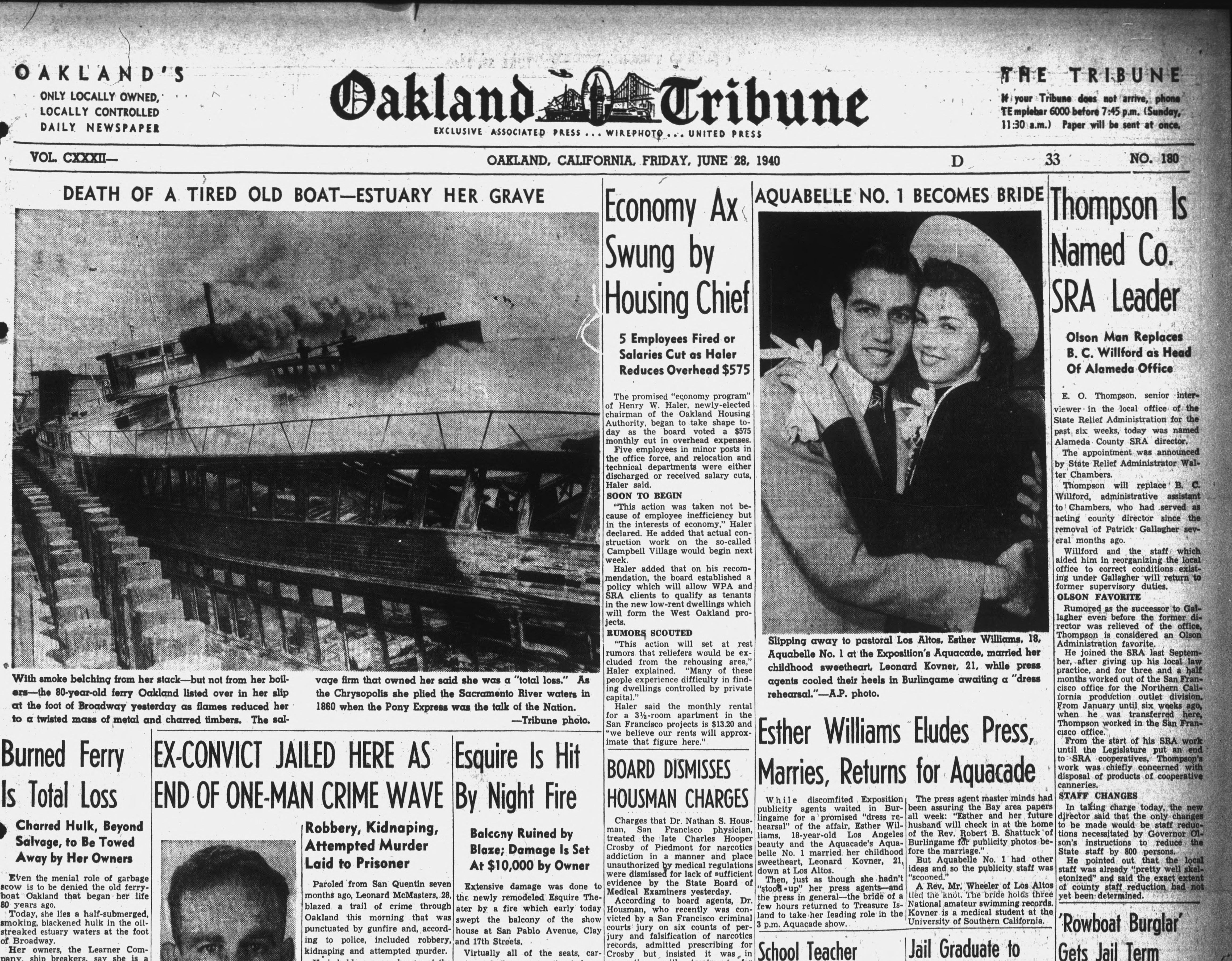
Esther was the last of her siblings to tie the knot, but neither her parents nor her siblings and their families were at the wedding, and it’s unclear if they visited San Francisco that summer. While the youngest Williams kid was lighting up the Golden Gate Exposition, her siblings were busy with their own lives. Maurine Williams Sellstrom, who turned 31 that year, was raising two daughters with her husband Lawrence while working on a PhD in Psychology. June, whom Esther used to bug with her tomboy tendencies as a kid, was also married and was working as a saleswoman. Their brother David and his wife Ruth had a one-year-old daughter.
Back to Work
The newlyweds put off a honeymoon and returned immediately to their pre-wedding lives. After all, the Aquaqueen had about 275 more waltzes to perform with Weissmuller in the three months before the Fair closed.
And it wasn’t all swimming: Esther had plenty to keep her busy outside of the pool. The Exposition often called upon its shows’ casts to model, present prizes, or make public appearances, and Billy Rose added extra duties to promote the Aquacade. So Esther and Weissmuller were photographed donating money to the Red Cross European War Relief Fund, the first of hundreds of Exposition staff and performers to contribute. In early August, the aquabelles modeled the fall collection in a fashion show presented by the Manufacturers & Wholesalers Association.
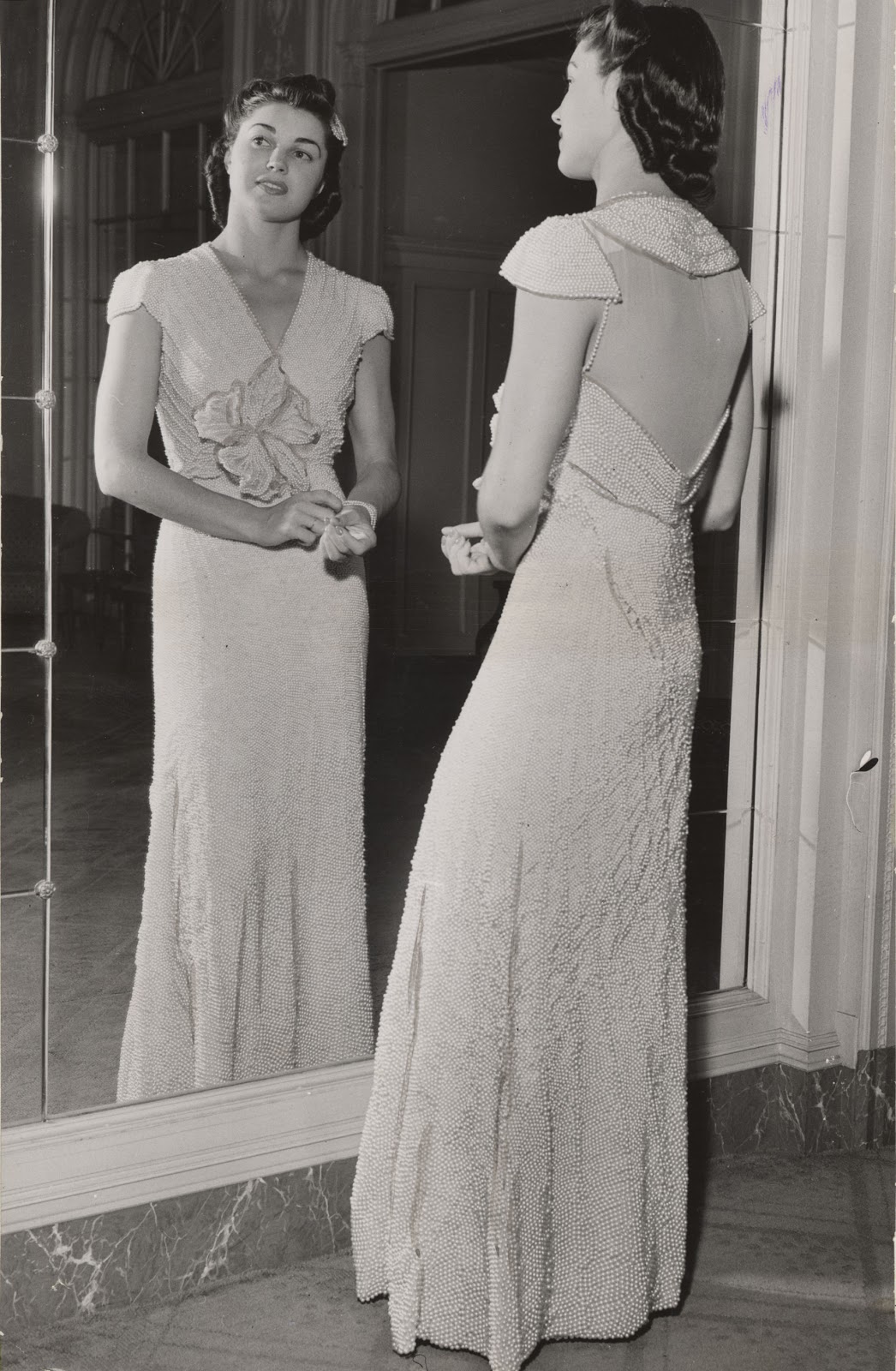
Esther wore the finale outfit, a $250,000 pearl gown described as “a streamlined shimmer of loveliness; lustrous breath-takingly beautiful as it caught the light.” In an ironic twist, the show-stopping, backless dress with an “orchid” of tiny seed pearls at the waist was “designed and created for the Imperial Pearl Syndicate by I. Magnin,” where a few months earlier Esther had worked as a lowly shopgirl. But now she was the Aquaqueen chosen to model the extraordinary gown.
Two days after the fashion show, Weissmuller and Esther, along with Morton Downey, Dorothy Lamour, and other celebrities, were guests at a luncheon hosted by the International News Service as part of the National Association of Broadcasters convention in San Francisco on August 7. It wasn’t all quite so glamorous, though. Later that month, Esther attended a morning softball game at the Oakland Ball Park between the local Jelton Motor team and the aquabelles (Weissmuller was the Aquacade squad’s celebrity coach), and awarded California wine to the lucky winners of a raffle on Wine Day in September. She didn’t know it at the time, but these fashion shows, luncheons, and raffles were just the beginning of a lifetime of public appearances, and served as early training for her movie stardom.
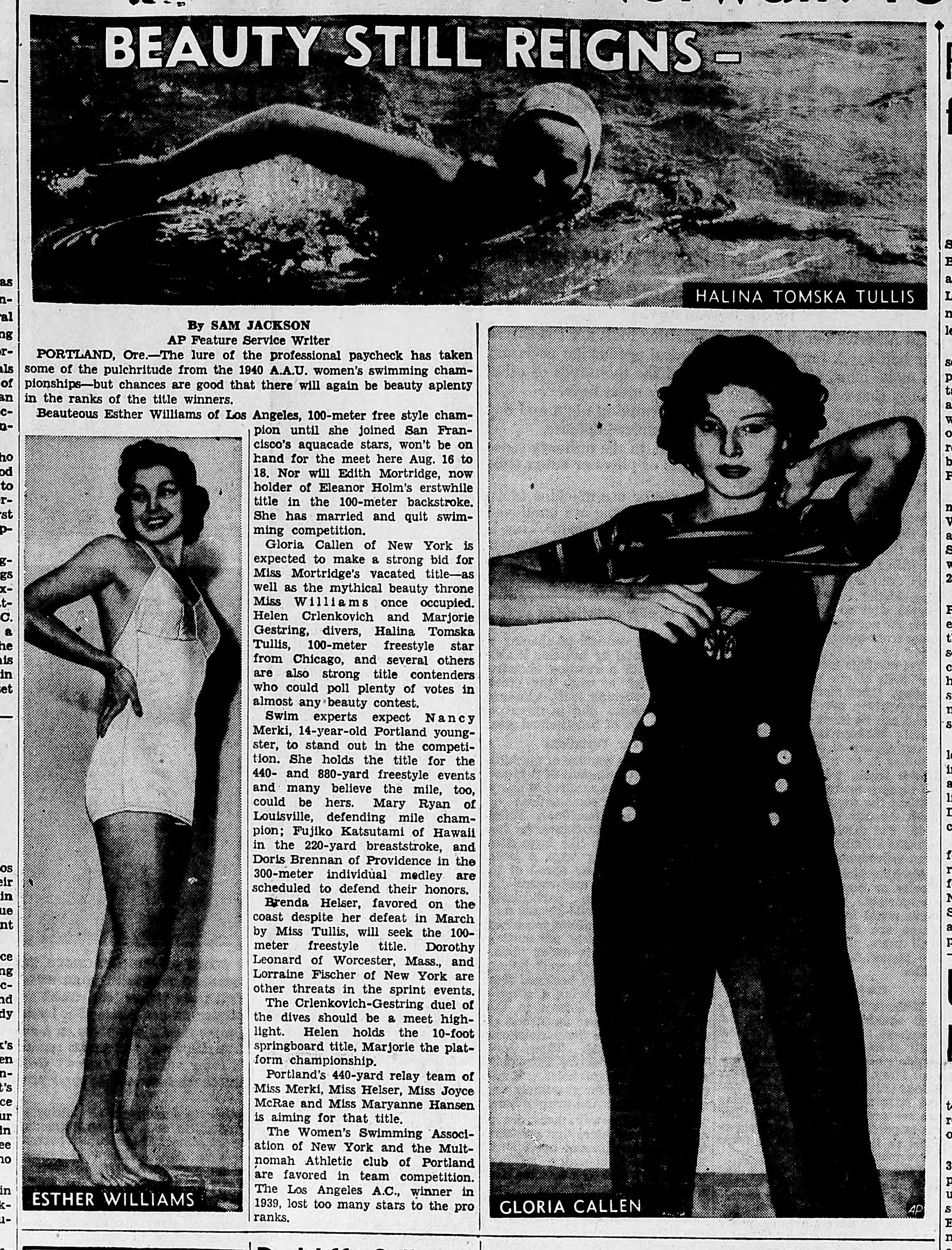
As Esther was busy with her Aquaqueen duties, the 1940 AAU national championships kicked off in Portland, Oregon on August 16. Esther had ruled the swim meet the previous July in Des Moines, winning the 100-meter freestyle race and crushing previous records in the 4 x 100 and the 300-meter relays with Virginia Hopkins and her other teammates. But a year later, she and Hopkins were busy performing water ballets at the Aquacade as amateur swimmers battled it out over the three day national championships. One wonders if Esther thought about former teammates and rivals as she swam “pretty” for enthusiastic audiences in eleven shows over the weekend. Did she regret her decision to turn professional, or was she glad to be Aquabelle #1 instead of racing across the pool defending titles and records?
She may not have been focused on the meet, but the sports pages were still focused on her. Despite her absence, a large, full-body photo of Esther in—you guessed it—a bathing suit accompanied an article about the upcoming meet. The story opens with, “The lure of the professional paycheck has taken some of the pulchritude from the 1940 AAU women’s swimming championships…” and first among the missing champions is “Beauteous Esther Williams of Los Angeles…” But the headline “Beauty Still Reigns” reassured readers that even though Esther had turned professional, there were other pretty girls competing in Portland. Thank goodness!
Thanks for reading and stay tuned for more!
Categories: History
 The Blonde at the Film
How creepy that “Tarzan” was such a dangerous co-star!