Glamorous Plumbing
This is the 14th excerpt from my biography of Esther Williams. You can find the other entries here. In the previous post, “Bathing Beauty,” MGM poured money into Sound Stage 30 in preparation for the first big “Esther Williams movie,” Bathing Beauty, which premiered in 1944. In this excerpt, I look at how the swimming musical was actually produced, from the newly invented cameras to the gooey mess the wizards in the Hair Department concocted to keep the swimmers’ tresses as glamorous wet as they were dry.
Once Stage 30 was ready, MGM finally got the chance to test if this swimming movie star thing could actually work. Production on the film began in August 1943, with most of the swimming filmed in early 1944.
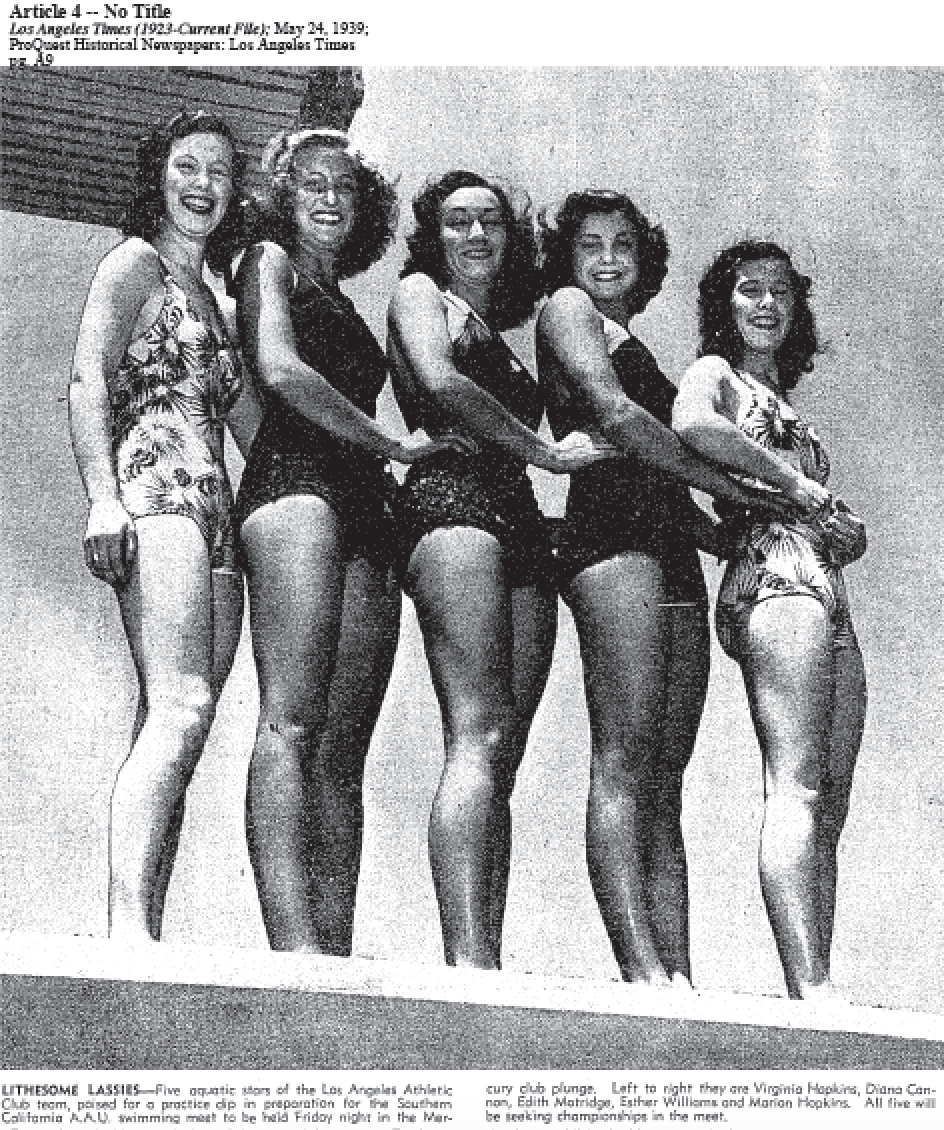
In a tidy turn of events, MGM hired John Murray Anderson, the choreographer of the San Francisco Aquacade (in which Esther had starred in 1940), to produce the water extravaganza. Another familiar face besides Murray turned up in the pool, too: Edith “Edie” Motridge, one of Esther’s teammates on the powerhouse LAAC relay team and a former Olympic backstroker (in the 1936 Games), was hired as Esther’s “swim-in.” Edie was the second swimmer to attempt the role: the original was fired on the first day when she sank to the bottom of the pool during a color test. She was supposed to tread water while holding the “lily,” a device with scene numbers and color charts that the lab used to check color balance while developing the film. But the swimmer wasn’t quite up to the challenge.
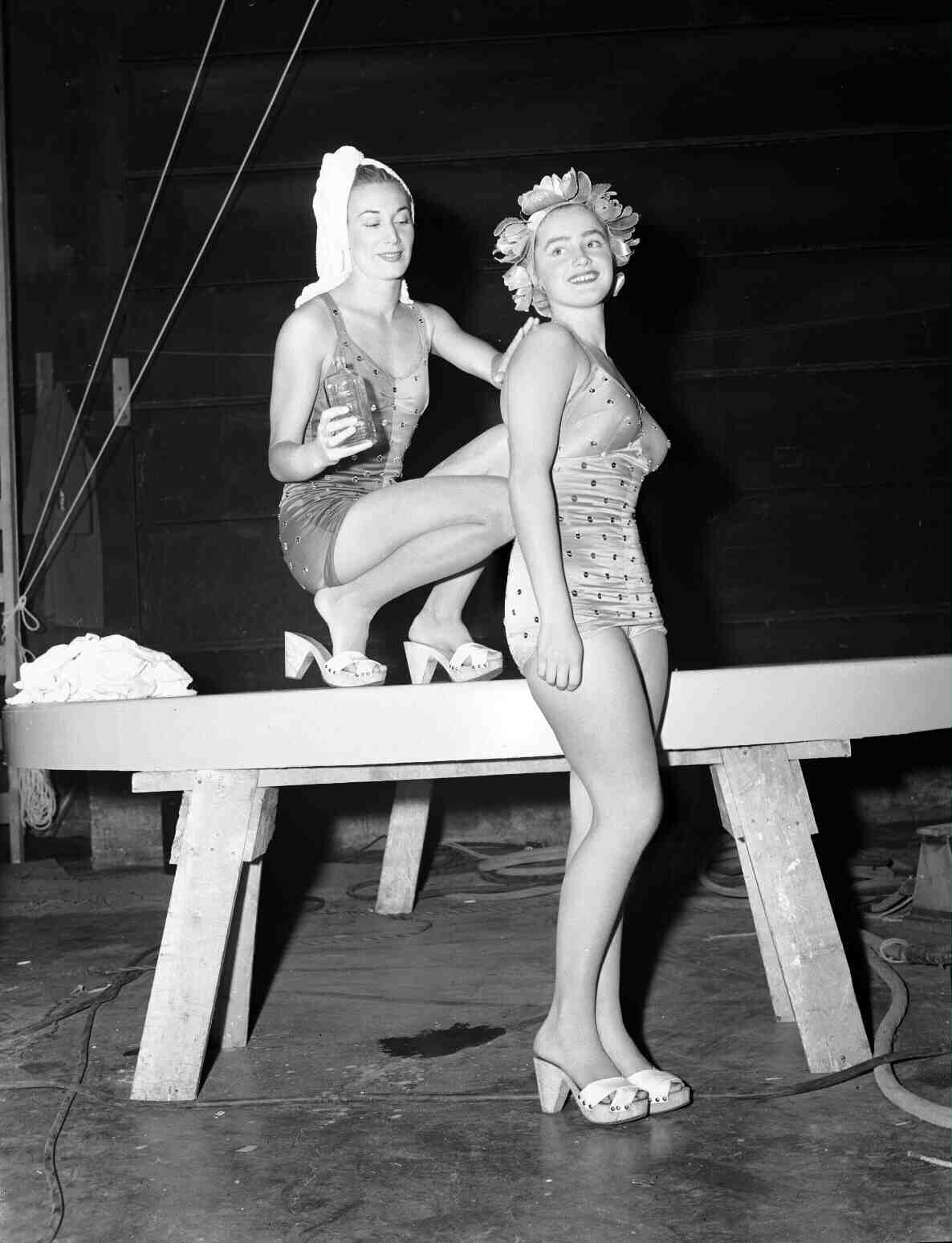
After that dismal performance, Esther suggested Edie, who was hired right away. They’d broken records together during their competitive swimming careers, and now Edie would be by Esther’s side during her movie career, too. But Edie appears to have been more than a swim-in; a photograph taken on the set shows Edie wearing the pink and green swimsuit sported by the other female swimmers, so she may have appeared in the finale, too.
MGM built a gigantic white set around the new tank in Stage 30 with tall columns, enormous pearly sea shells, and shallow stairs extending into the water. A reporter named Maxine Garrison visited the set in early 1944 and was awed by the spectacle:
Before us lies a rectangular pool. ‘Pool,’ we realize, is a pathetic understatement. It’s a body of water more than half a city block long, and almost as deep. From three sides rise dazzling white stairs and around those three sides also rise gigantic white pillars—almost 60 feet high—festooned with flowers…
According to Esther, the pillars were more than just colossal decoration and also served as visual marks for the swimmers to help them stay in sync.
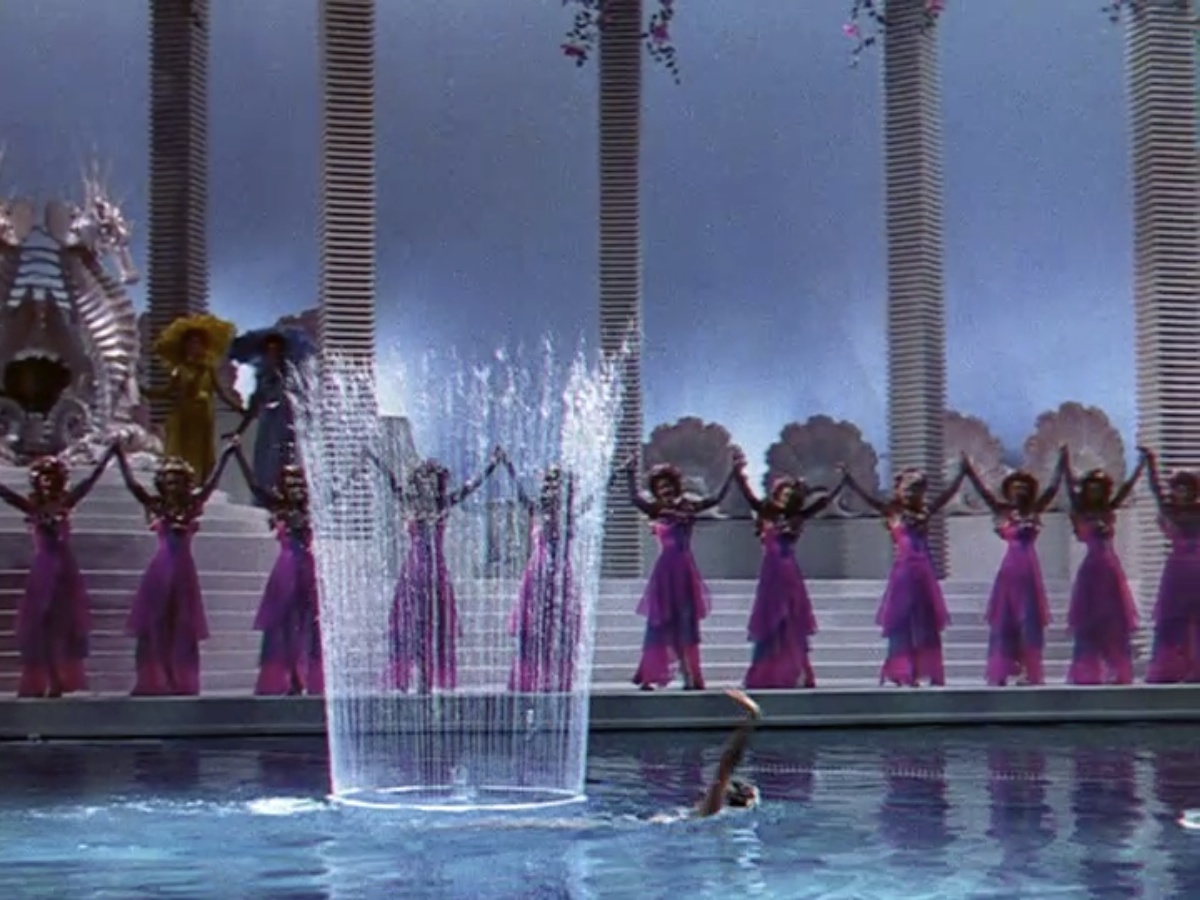
Once the set was in place, the company of 150 swimmers, dancers, and dozens of crew members went to work under Murray’s guidance. It was a hugely complicated number featuring a large cast and many new technologies, and rehearsals lasted for 10 weeks. As Variety noted, “Producer Jack Cummings apparently was given the ‘go-ahead’ signal on unlimited expenditures,” and the finale is unrestrained spectacle. As Esther said later, “The engineering department adored me because they got to play with all this innovative equipment. Never had plumbing been put to a more glamorous use.”
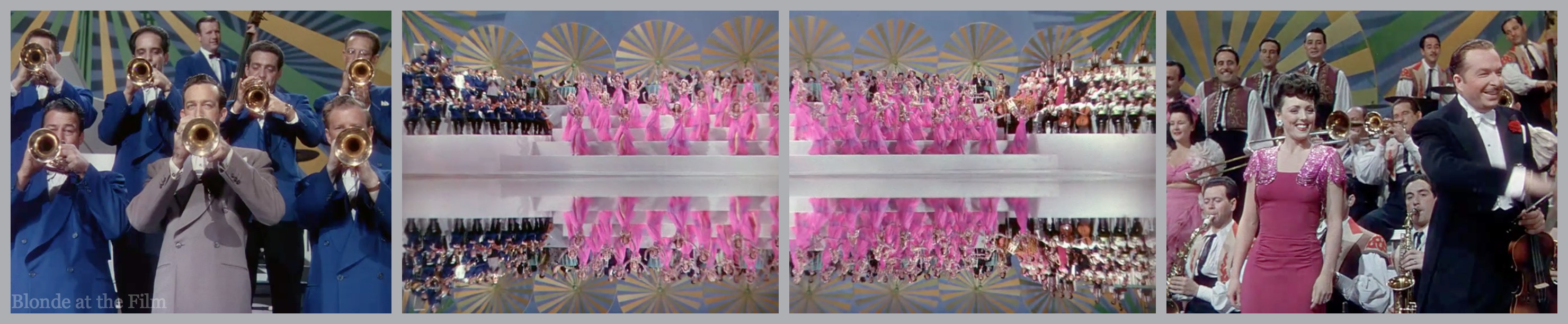
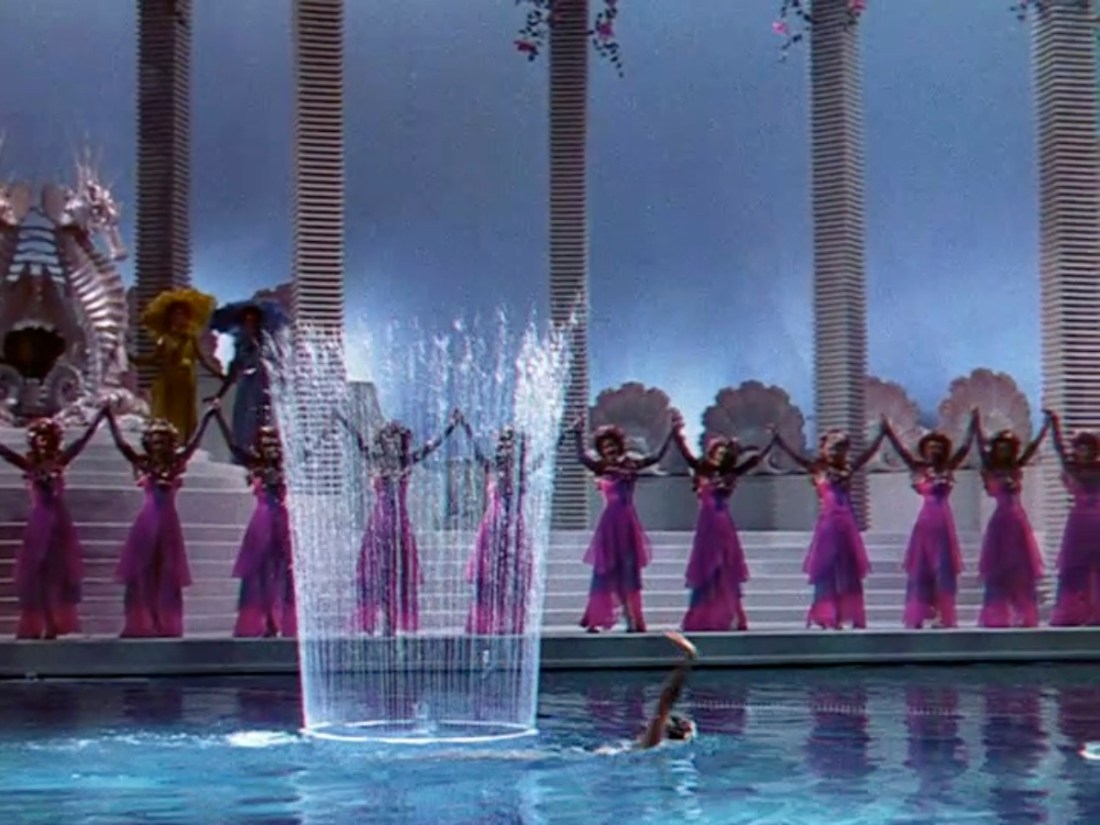
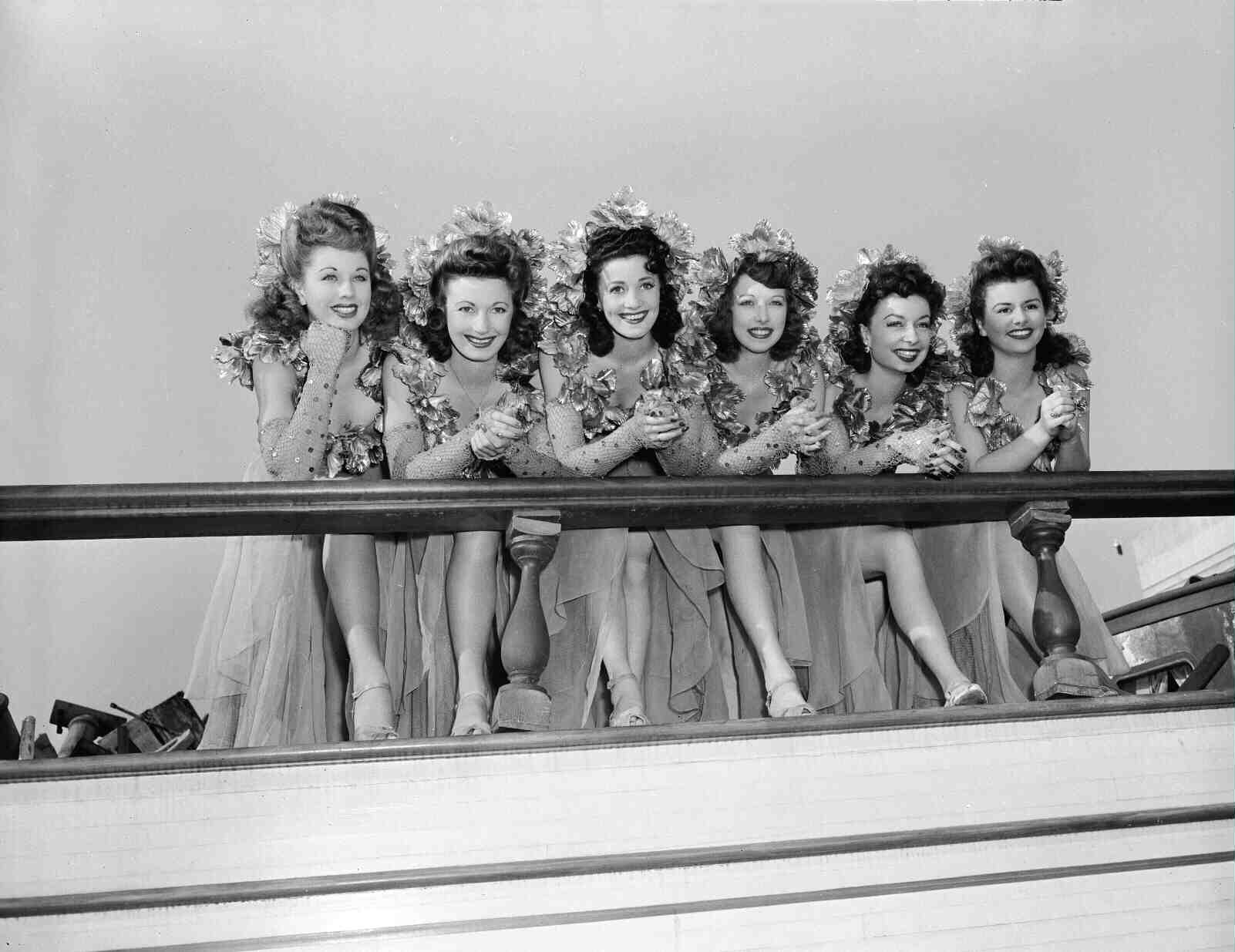
The number starts with 150 female dancers in floaty, tiered dresses of shocking pink and purple, huge flower crowns, and sparkly, sheer gloves around the pool’s edge. They jive and twist to Harry James’ band on one end and Xavier Cugat’s on the other. (Both bandleaders were under contract to MGM at the time.) The dancing soon turns to water ballet when 46 ladies line up along the edge of the pool and open their short, pink satin capes to reveal a contrast lining of bright green.
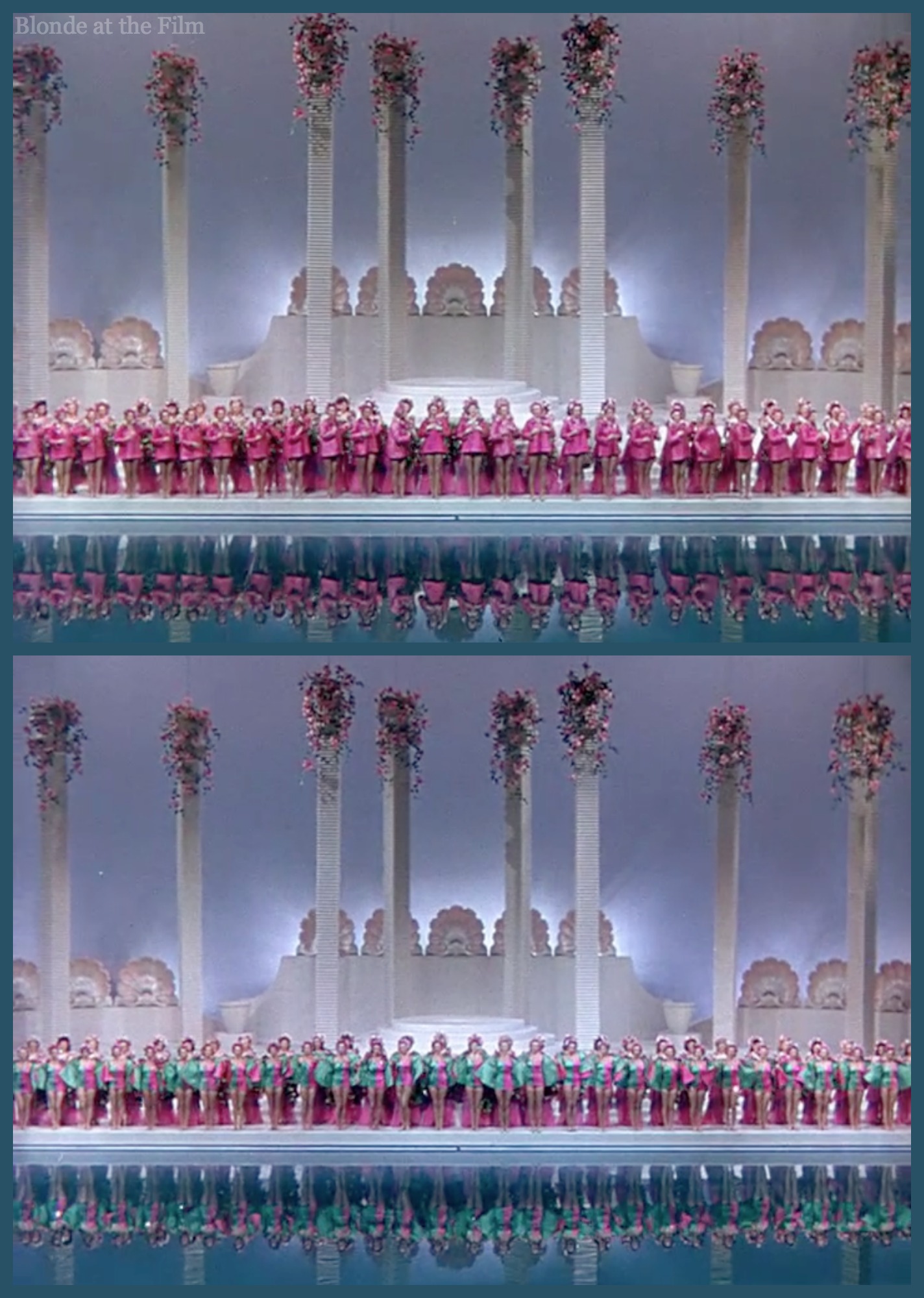
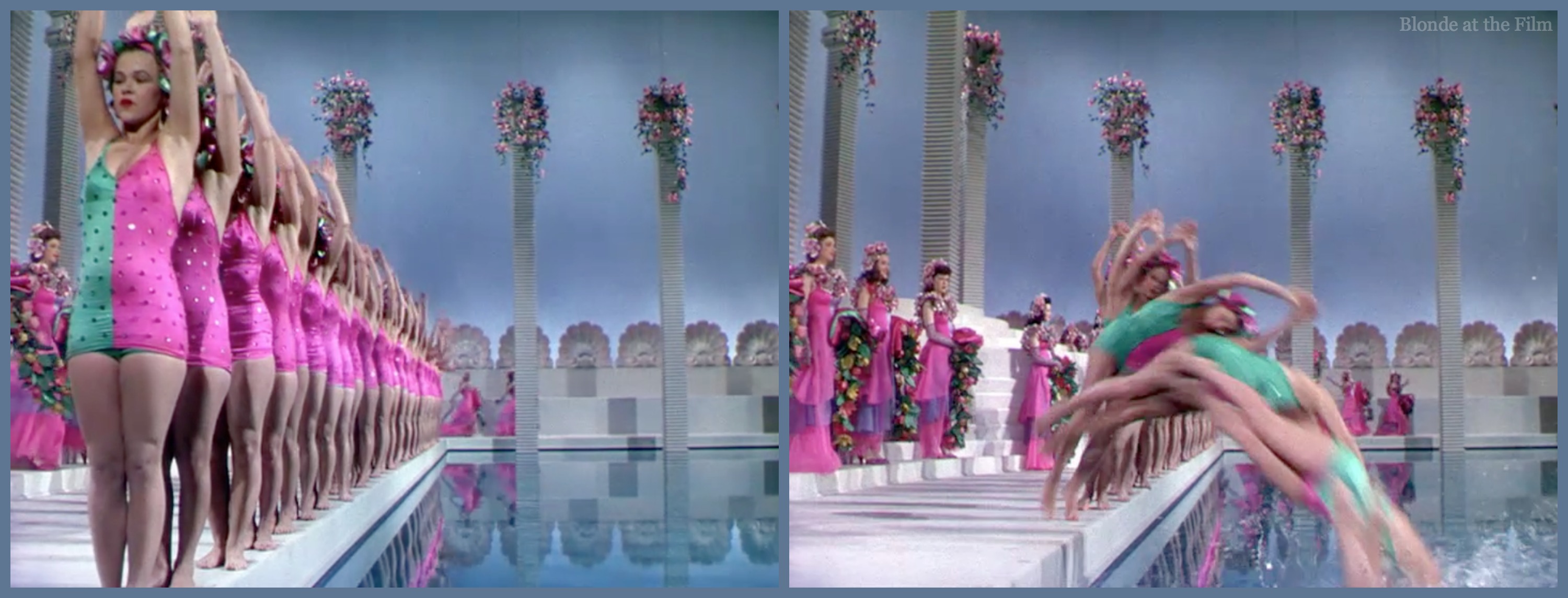
The simple, synchronized cape-opening is surprisingly effective as it turns the stripe of hot pink to green in one swift motion. The effect is doubled because the pool’s edge is perfectly aligned with the bottom third of the frame, and this composition takes advantage of the mirror-like surface of the still water so that the swimmers are perfectly reflected in the pool. The color coordination and design continues as the swimmers reveal their sparkly, color blocked bathing suits of watermelon pink and lime green and perform a synchronized “tiller dive” into the turquoise water.
Then Esther appears, rising from beneath the stage on a sea-horse lift where pairs of abnormally tall women (they were all six feet tall) wearing huge hats and partially sheer gowns in black, cornflower blue, and marigold wait for the star. They divest Esther of her snowy chiffon robe, glittering belt, and short, one-shoulder toga to reveal a white suit covered with tiny mirrors.
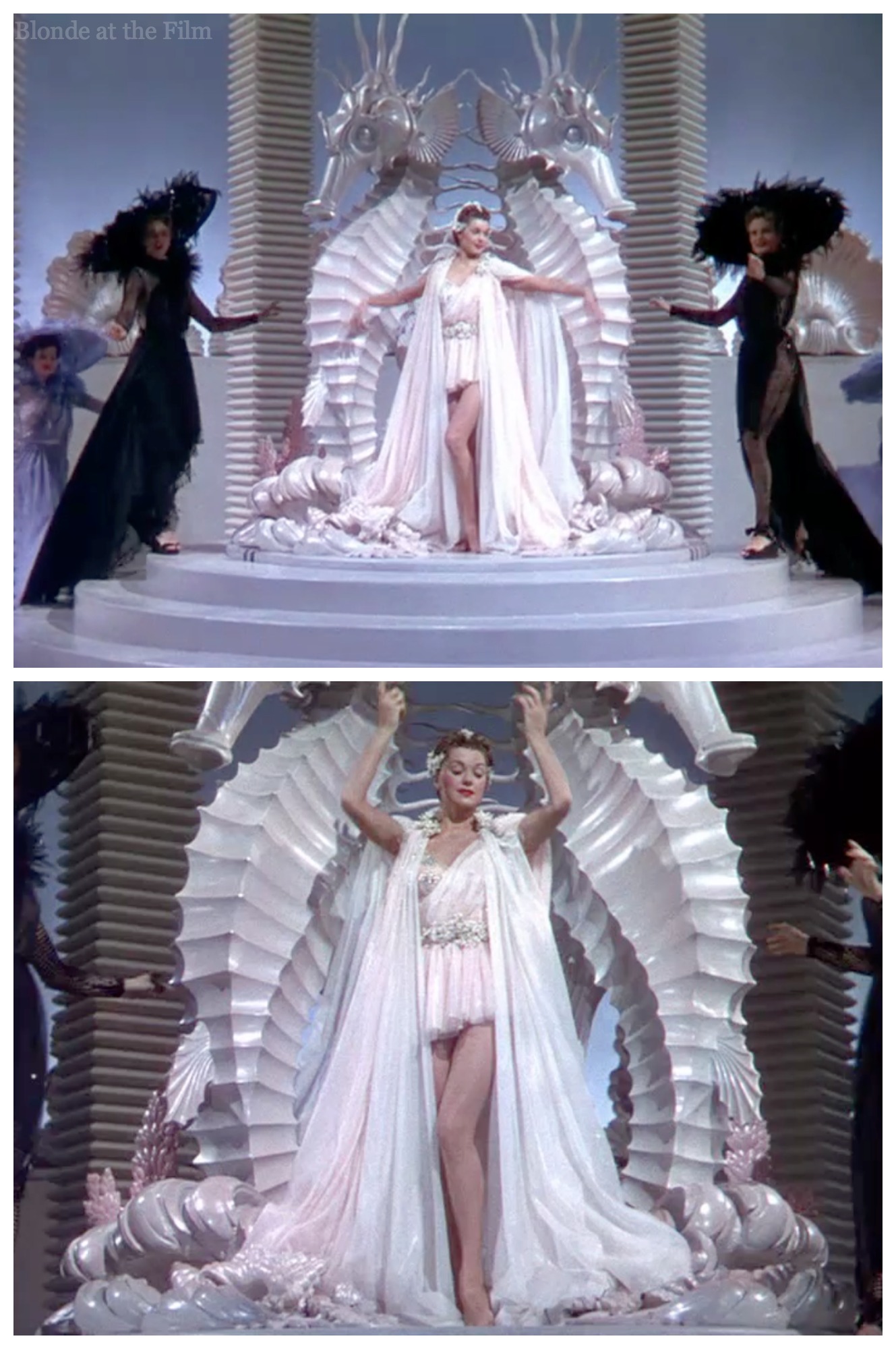
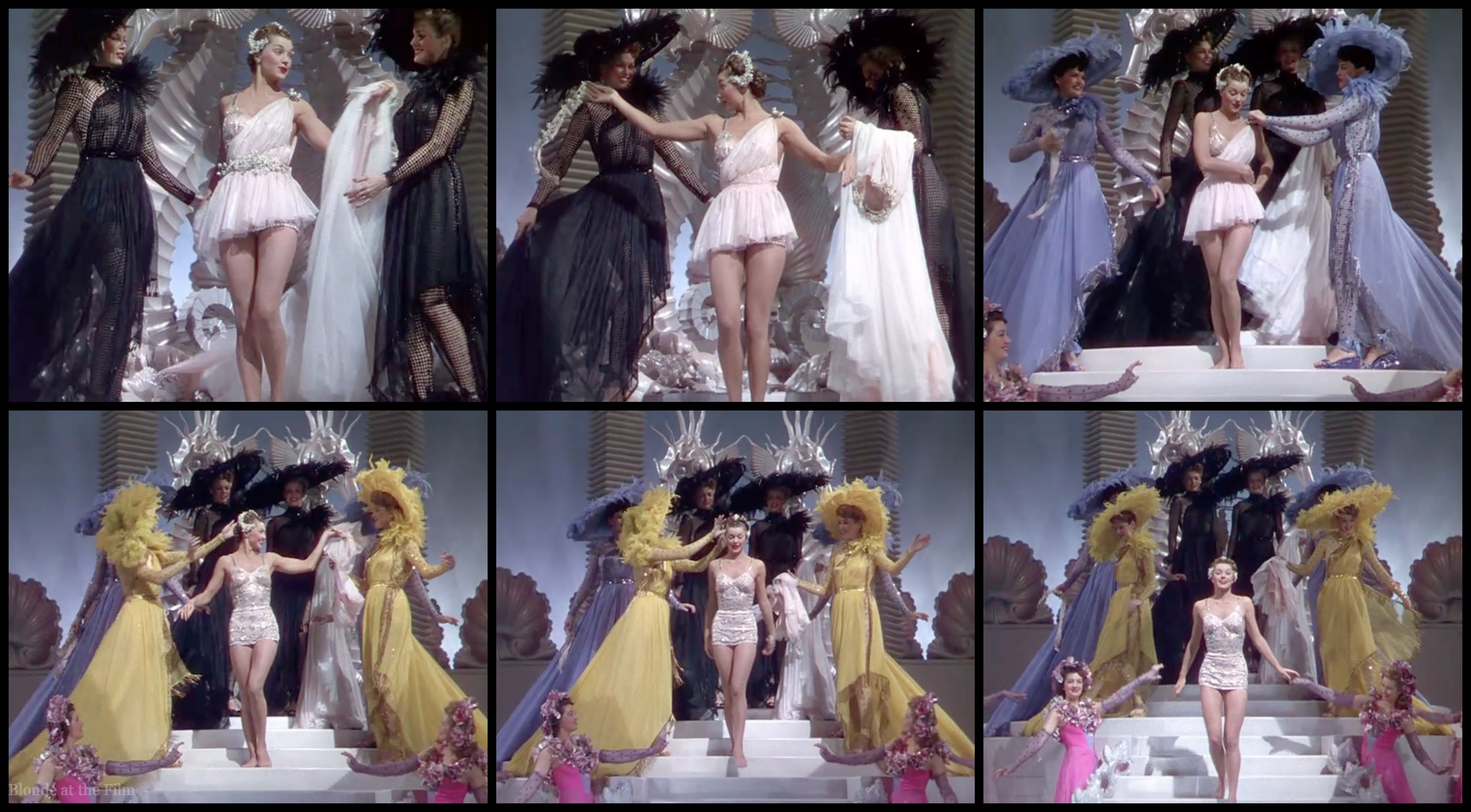
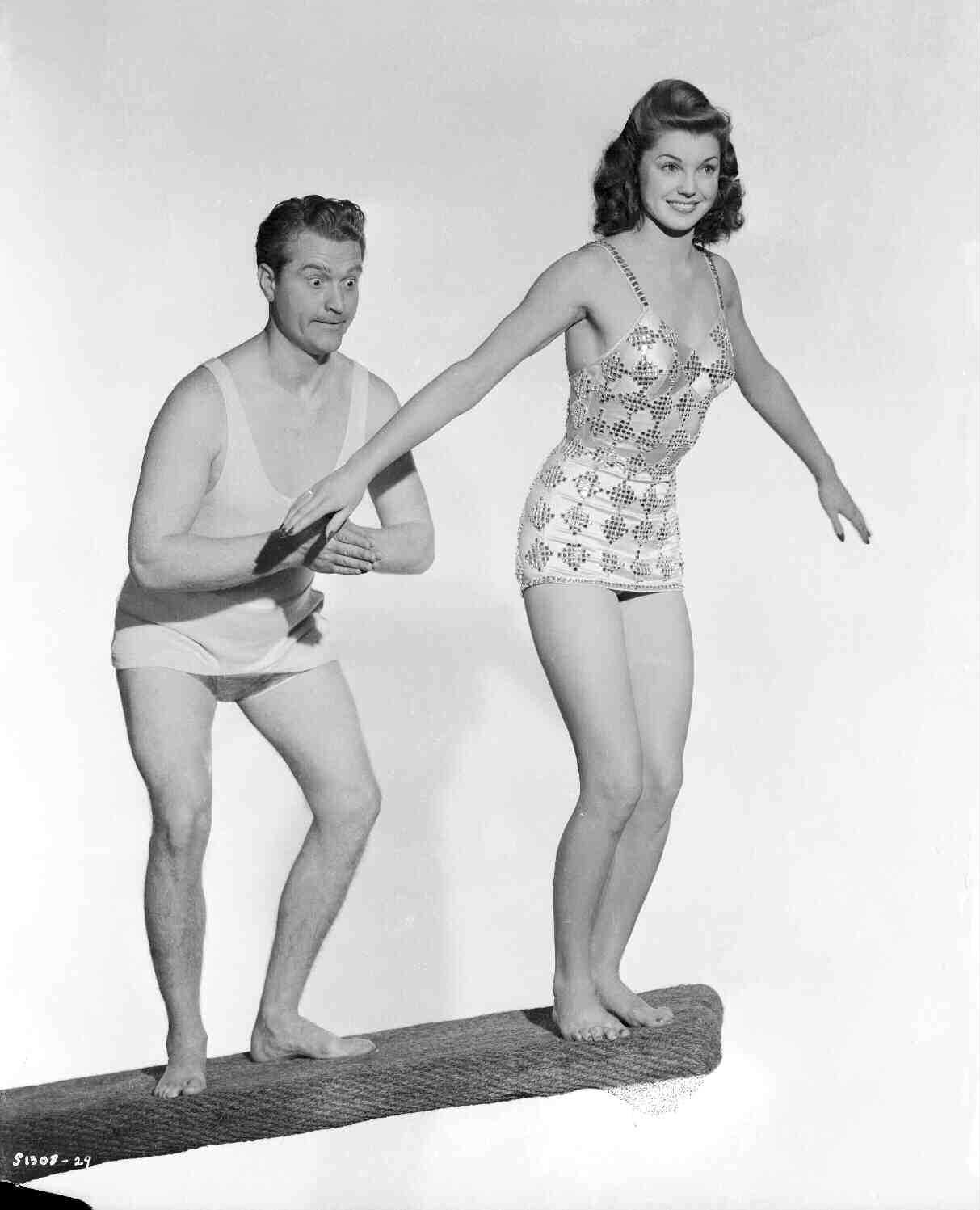
Hedda Hopper described how Esther “swims in what looks like her own epidermis with diamond-shaped mirrors pasted on her”—indeed, argyle has never looked so sexy nor so glamorous. Esther’s outfit, and her intricate, pearly headdress have a definite Roman goddess vibe which clashes pleasantly with the Victorian showgirl look of the women around her. She certainly sticks out in her glittering white suit amongst the pink and green of the dancers and swimmers she leads.
Once freed from her assorted accessories, Esther strides quickly down the clean white stairs as Strauss’ “Die Fledermaus Overture” replaces the big band sound of the previous sequence. She dives into the water as though anxious to finally prove herself and this new kind of “swimming musical.”

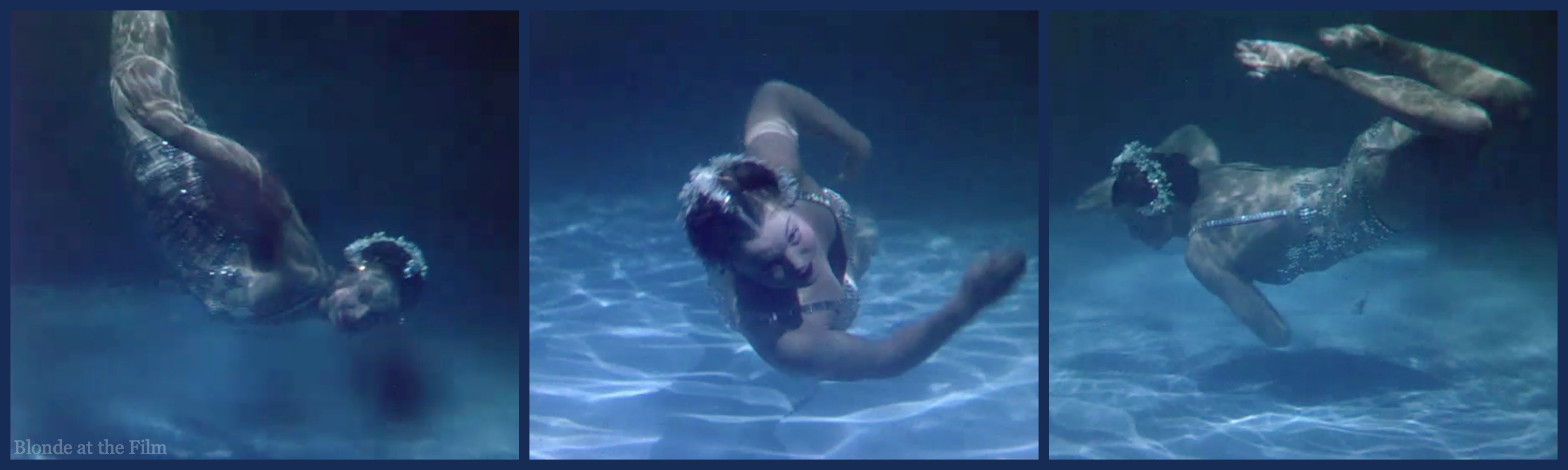
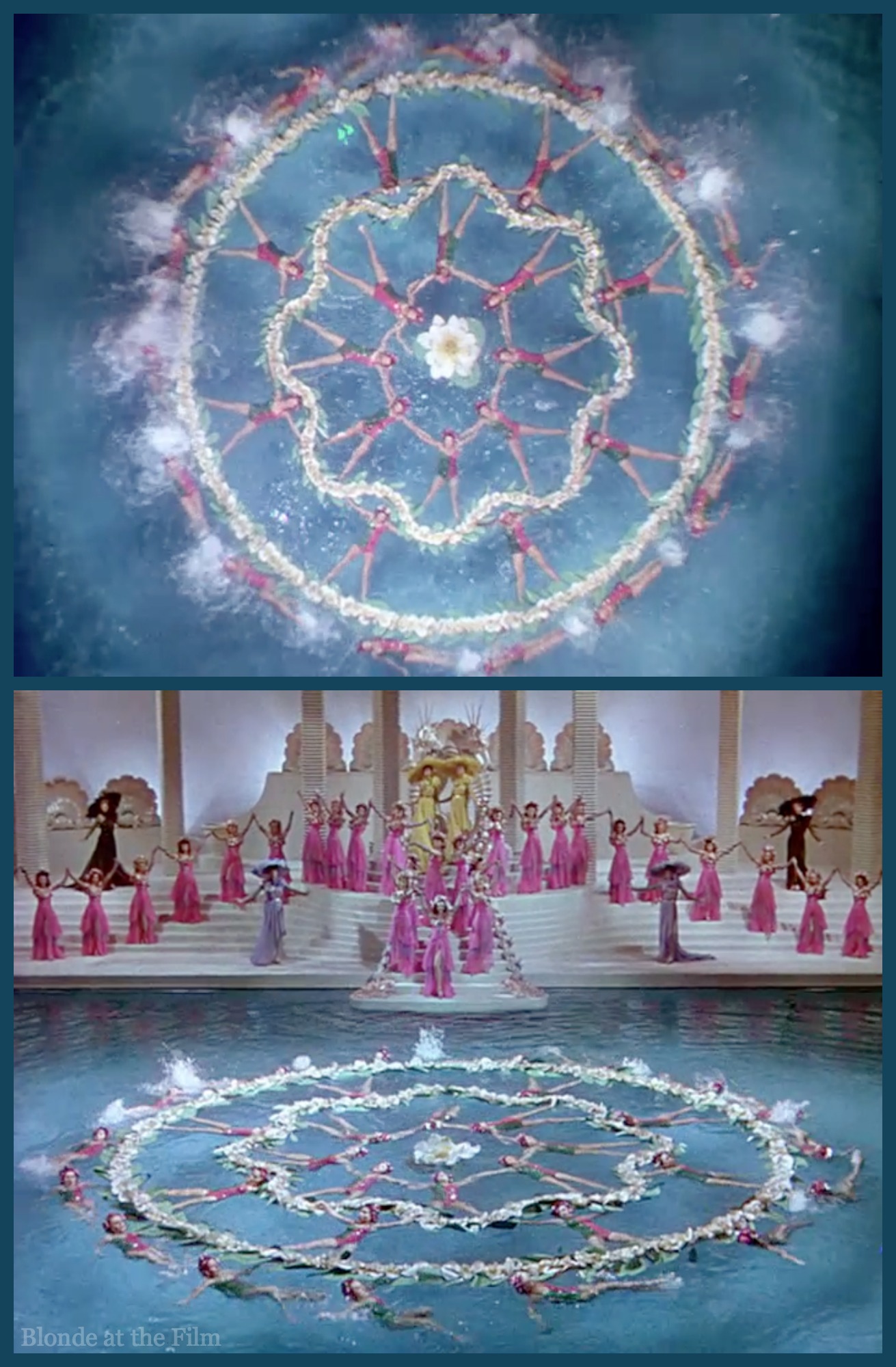
The camera seamlessly swoops below the water to follow Esther and the swimmers as they frolic in the deep. They perform synchronized strokes in perfect lines, and create kaleidoscopic images with enormous garlands of flowers. Frequent overhead shots capture the choreography and visual splendor, interspersed with dips below the water to watch Esther paddle through tunnels of rotating swimmers, and flip and twist beneath the surface.
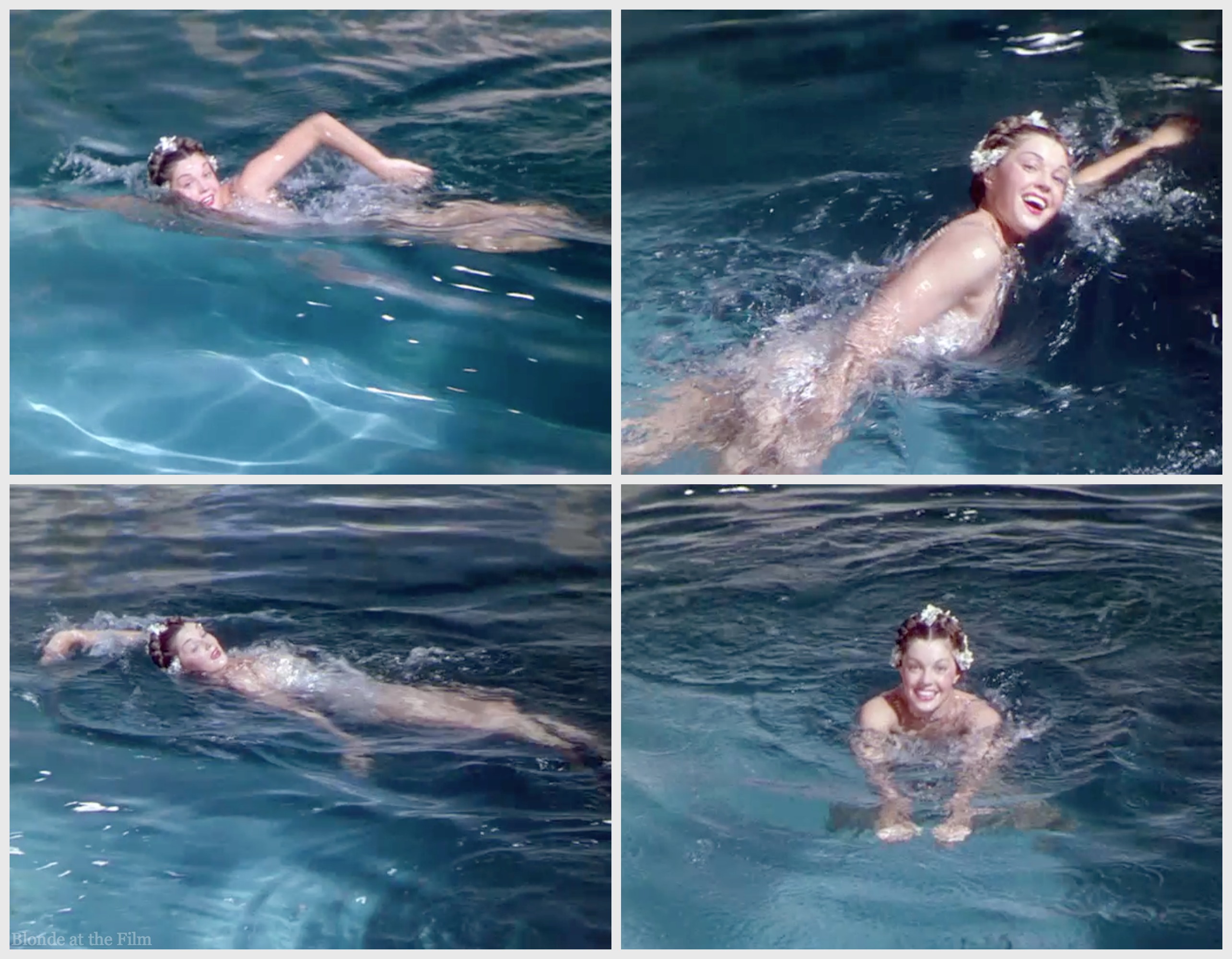

The finale comes when Esther summons fountains of colored water and geysers of flames with a flick of her wrist as she swims by while dancing ladies keep busy in the background. Finally, Esther rises on a platform in the center of the pool. She smiles widely, framed by swimmers and flaming fountains as a curtain of water encloses the star. The camera pulls back to take in the whole, stunning tableau as the music surges to its end.
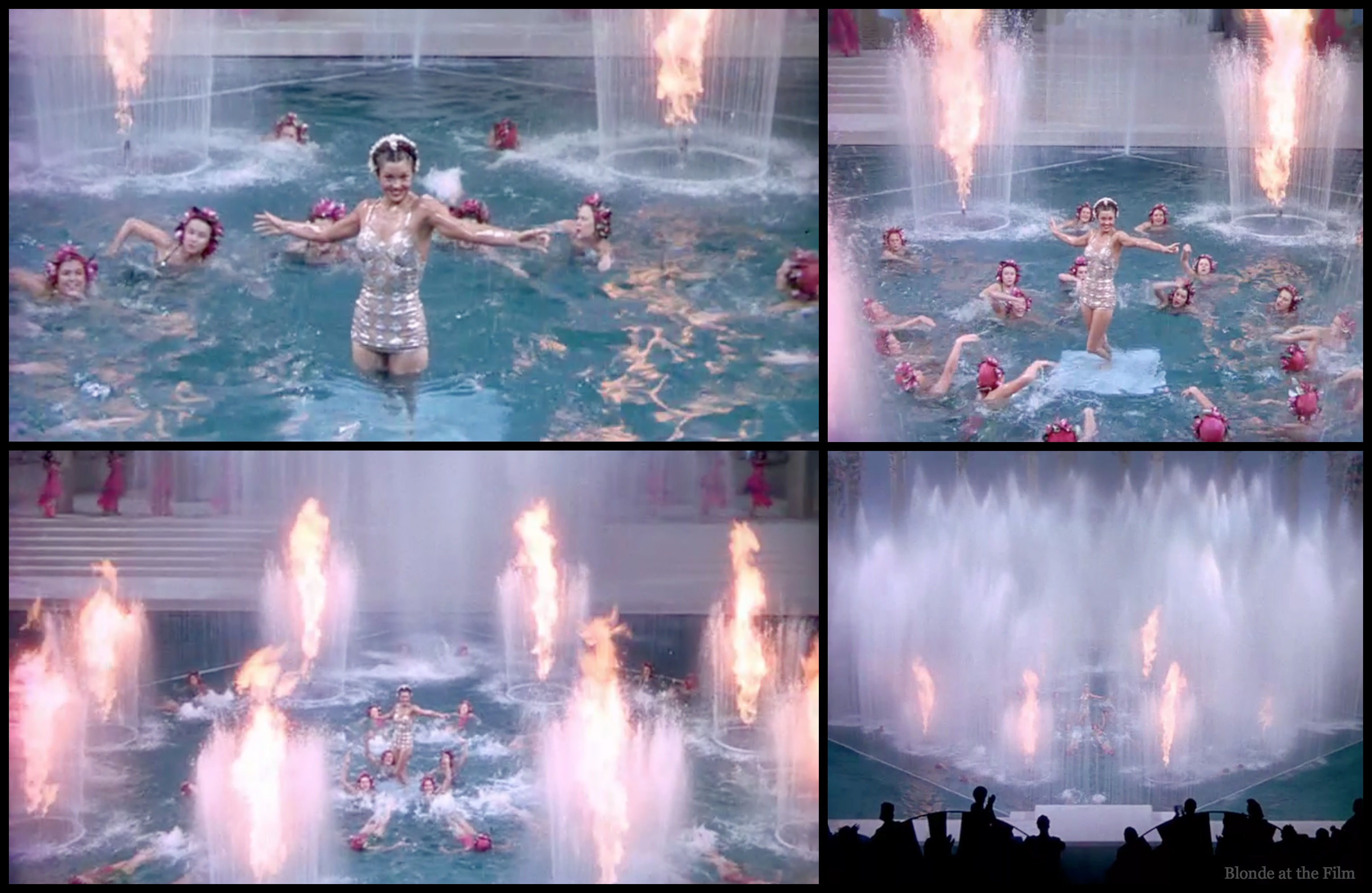
It was unlike anything that anyone had ever seen, and the first water ballet of its kind to be filmed, excepting Busby Berkeley’s wildly inventive “By a Waterfall” in Warner Bros.’ musical Footlight Parade (1933) eleven years before. That ten-minute production number featured a six-tier, revolving human waterfall composed of sixty women, an actual waterfall flowing with 20,000 gallons of water per minute, and a glass tank measuring 80 by 40 feet. 100 female swimmers in suits designed to look invisible (the risqué “nude” look slipped through pre-Production Code) posed prettily, slid down the waterfall, and dove in highly choreographed sequences. They performed remarkable, kaleidoscopic routines, and the tank’s glass walls and floor enabled Busby Berkeley to capture the spectacle from every angle. International Photographer magazine called it a “production miracle,” the audience at the premiere gave the scene a standing ovation, and critics hailed the number, with Picture Play magazine describing the extravaganza as “literally stunning.” The scene made such a splash that Billy Rose asked Busby Berkeley to direct his Aquacade. Rose wasn’t able to lure him away from Warner Bros., though.
But Bathing Beauty outdid even “By a Waterfall.” MGM took advantage of the leaps in technology since Warner filmed their water ballet in the summer of 1933, and went bigger and brighter. The addition of Technicolor makes an enormous difference, the scale of Bathing Beauty’s set dwarfs the previous film’s, and the various fountains, lifts, and pyrotechnics add a new element. But it’s not just the technology and brilliant color that sets Bathing Beauty’s finale apart, though: the addition of a photogenic, athletic star adds a personal element that’s missing from the machine-like precision and resulting detachment of “By a Waterfall.”

Hollywood has a short memory, but critics were right to hail Bathing Beauty as something special. Variety’s review calls the finale “unusual in every respect, probably the most ingenious water ballet sequence ever filmed:”
The swimming prowess of Esther Williams, an alluring subject for the color cameras, is insinuated into gorgeous water spectacle with ensembles and routines in which the art directors, the costumers, the ballet masters and the cameramen go the limit in pictorial elegance and spectacular effects.
Hedda Hopper wrote that the finale sequence was the only thing that could top the enormous production number “A Pretty Girl is Like a Melody” in The Great Ziegfeld (1936), another MGM spectacular, and added that if the water ballet “didn’t knock your eye out we might just as well stop making pictures.” And The Washington Post raved about the
multi-colored magnificence of the water carnival and ballet…with Miss Williams as its central figure, this mammoth conception presents a spectacle of beauty and imagination such as no screen ever before has approached. One suspects that, with memories of his own Aquacade in mind, Billy Rose, upon viewing this number, would turn a livid green.
Watery Innovations
Achieving this “multi-colored magnificence” was not easy. In fact, Bathing Beauty was incredibly important and even groundbreaking for technicians and craftspeople at MGM. Since no one had ever filmed anything like the finale before, the problems to be solved were numerous and fundamental. Simply capturing the finale on film was actually far more demanding than one might think. Bathing Beauty pushed MGM’s technicians to create new technologies and methods, and the various departments and personnel responded beautifully. After all, the studio system was uniquely suited to solve these challenges because the people and tools were already in place with all of MGM’s resources behind them. (You can read more about the studio system, and MGM in particular, here.)
First, they tackled the problem of underwater filming. Shooting through windows in the saucer tank had been fine for the underwater kiss in Andy Hardy’s Double Life, but it wouldn’t suffice for the complex underwater choreography Murray planned for the finale. Experiments with existing underwater cameras didn’t deliver the desired results, so John Arnold and his staff in MGM’s camera department devised a new camera casing called the “maresphere,” or “sea-globe.” It was a “giant glass-enclosed washtub” that half-floated on the water with a camera and operator inside the watertight bubble. A special crane attached to the maresphere enabled smooth transitions in and out of the water, giving the contraption greater mobility than previous submarine cameras. And a wide-angle lens (a must for correcting the effects of light refraction underwater) could capture swimmers above and below the surface for seamless shots. “It’s the darnedest thing you ever saw,” wrote gossip queen Hedda Hopper when she visited the set and saw the maresphere in action. It “does almost as many tricks as the girls in the water.”
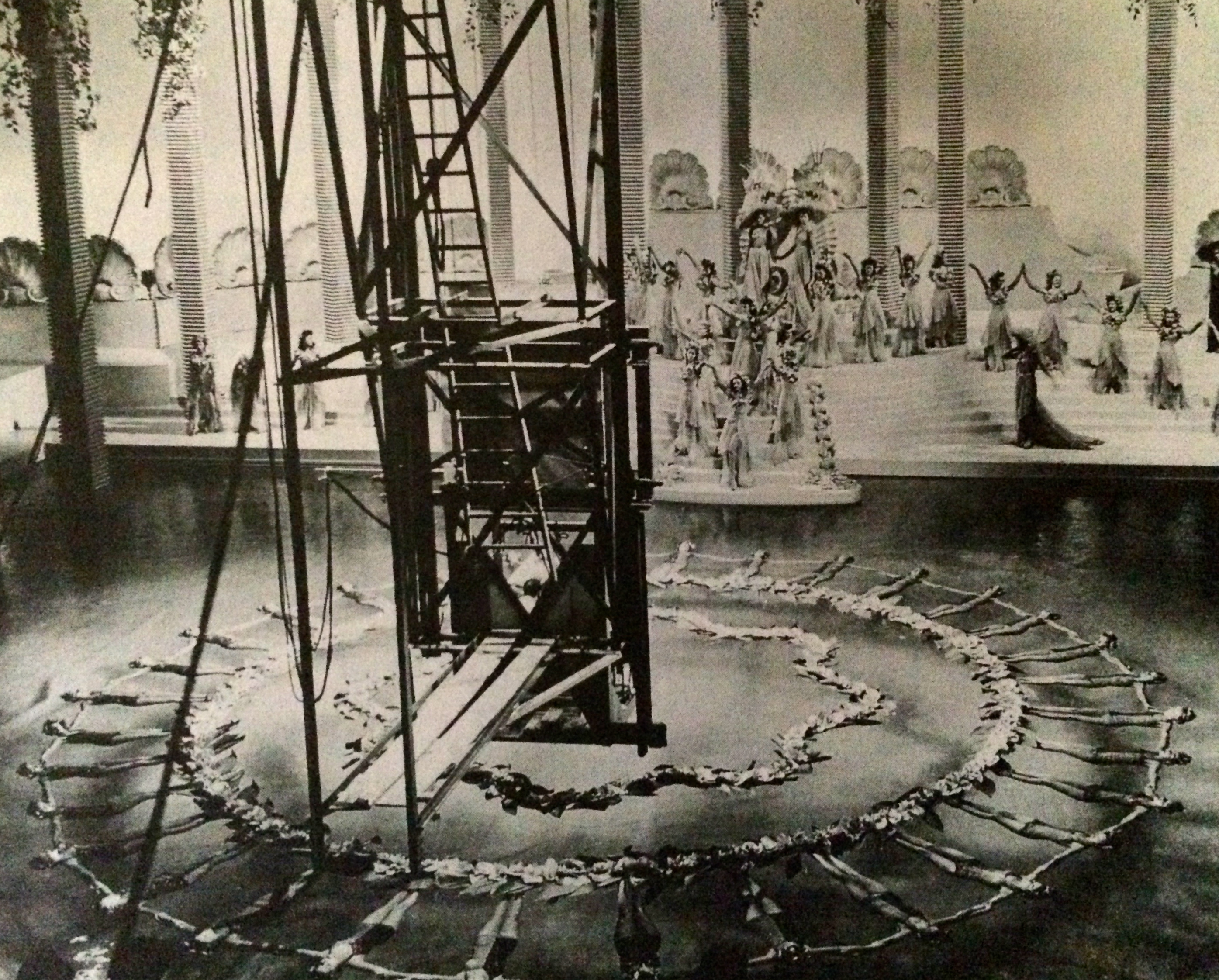
The maresphere enabled underwater shots, but MGM built an intricate system of scaffolding and tracks on the ceiling of the soundstage to capture the many overhead angles. As the visiting reporter Garrison wrote, “Look up into the rafters, and you’ll see overhead tracks like those to which a traveling crane is attached in a steel mill. The camera, in turn, is on a platform attached to just such a crane.” This “crow’s nest” platform was just big enough for the camera and four people. Photos from the set show what looks like a wooden elevator minus the walls with paltry wooden slats stretched across the front and sides to keep people from falling into the water. The platform could be lifted and lowered above the pool via steel cables to capture overhead shots, but the attached crane was used, too. The crow’s nest, crane and tracks assembled above the pool, along with the platforms and rigging built to hold the lights and technicians, crowded the space above the water. But they enabled the camera to catch the swimmers as abstract kaleidoscopic forms worthy of Busby Berkeley.
Something as simple as working in Stage 30 turned out to be a challenge, too. The water was kept pleasantly warm for the swimmers, but heat rose from the pools and created a stifling, chlorine-laced environment for the people stationed in the rigging high above the tanks. To counteract this effect and keep the crew from passing out and falling into the pool (a not unusual occurrence), the air was cooled to a chilly 60 degrees. That meant that the swimmers were constantly catching colds as they transitioned from the 85 degree water to the 60 degree air, and back again. The soundstage quickly became known as “Pneumonia Alley.” In fact, Esther was battling pneumonia as she filmed scenes for the finale in late December 1944. But the show must go on even when the star has a fever and can barely breathe. Too much time and money was at stake to allow for any delays in the filming, so Esther got through it.
Later, Esther learned to avoid the perils of Pneumonia Alley by never getting out of the water. She even took naps during breaks by hooking her heels on the edge of the pool and dozing off as she floated.
Watery Glamour
While the camera department and engineers were busy figuring out how to film water scenes, the set, costume, and makeup departments were working to ensure that the images the new equipment captured would be up to MGM’s standards of beauty and glamour. But they had to be creative; for example, the finale is full of flowers: they tumble from the tops of the pillars, adorn the hair and costumes of the dancers, and form beautiful concentric circles of 18-inch thick garlands in the water. But real flowers wouldn’t work, and neither would typical artificial ones. Instead, the prop department crafted pink, white, and green posies of rubber and glued them to cork so they would float on the surface.
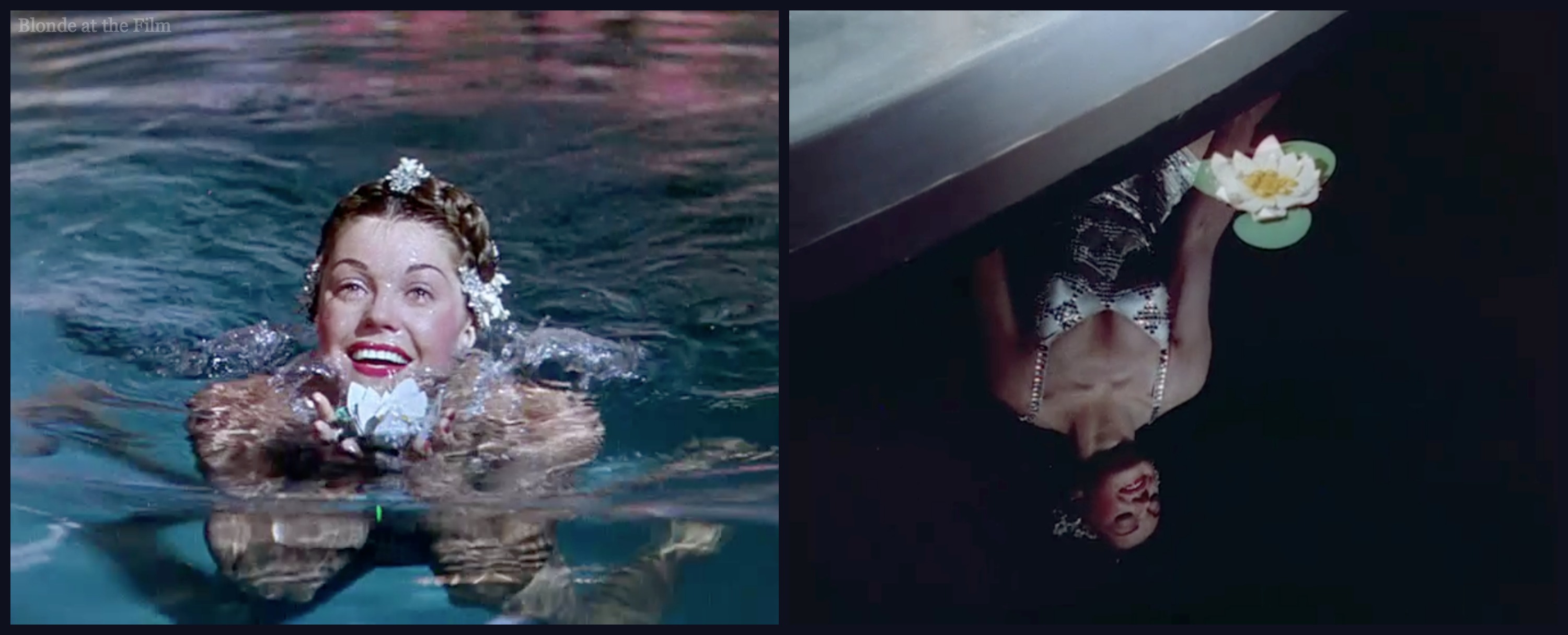
The people needed to look pretty, too, as a bunch of bedraggled swimmers in saggy suits with runny mascara would not cut it. So the makeup department went into action. Some waterproof makeup did exist at the time, namely a line by makeup mogul Helena Rubinstein (a fierce competitor of Elizabeth Arden). Rubinstein created waterproof “Aquacade” cosmetics, including cream foundation, powder, mascara, “indelible” lipstick, and protective hair lotion (all sold for $1 at department stores in 1940-1944). In 1942, most likely in response to the shortage of stockings during WWII, Rubinstein added water resistant “Aquacade Leg Lotion” make-up to the range, too. The line was marketed as the makeup used by Billy Rose’s “Aquacade girls” in New York and San Francisco, but “Even if you don’t swim,” promised the ads, “You’ll find it wonderful for all-day wear…you can dance the whole evening and not have to worry about renewing your make-up.”
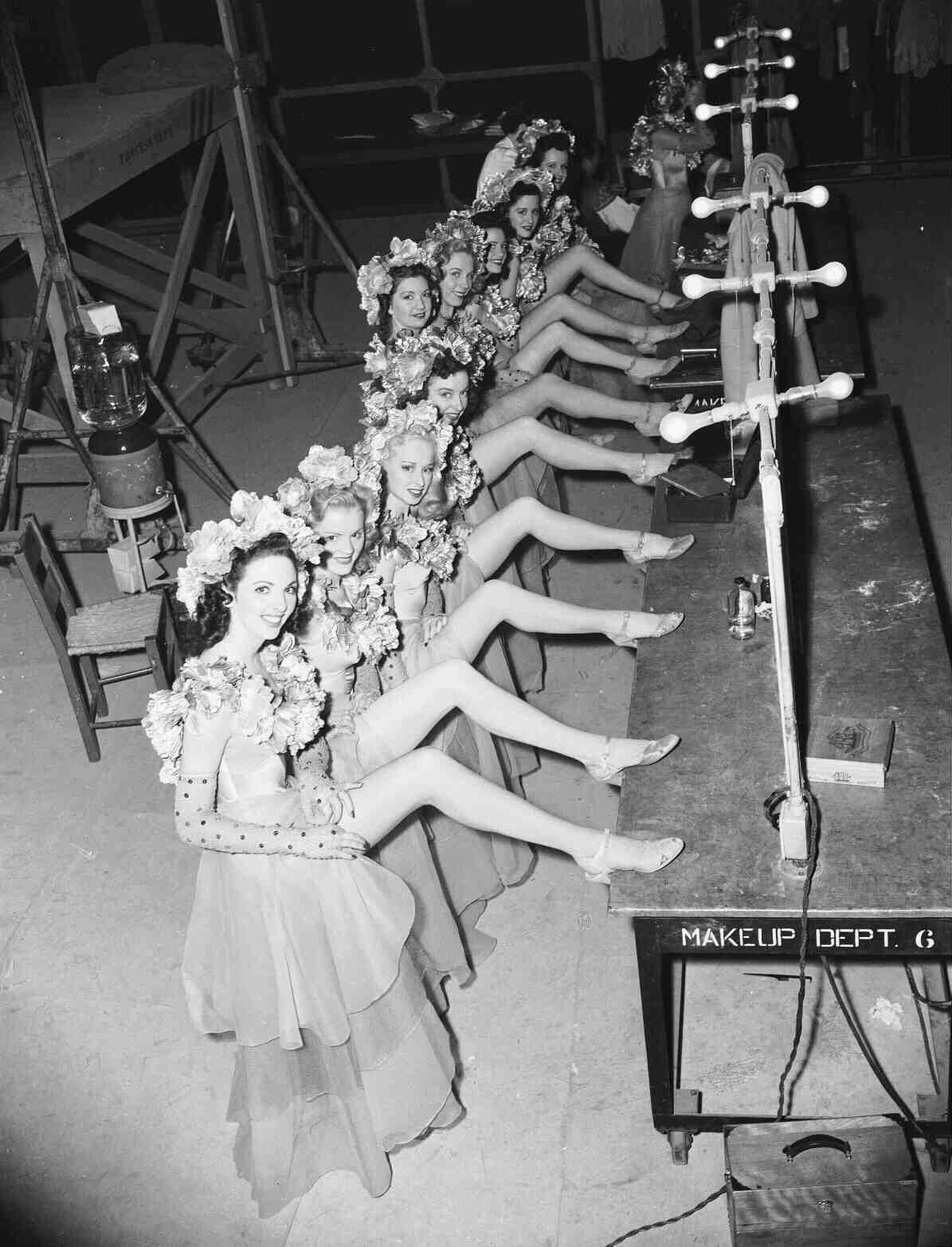
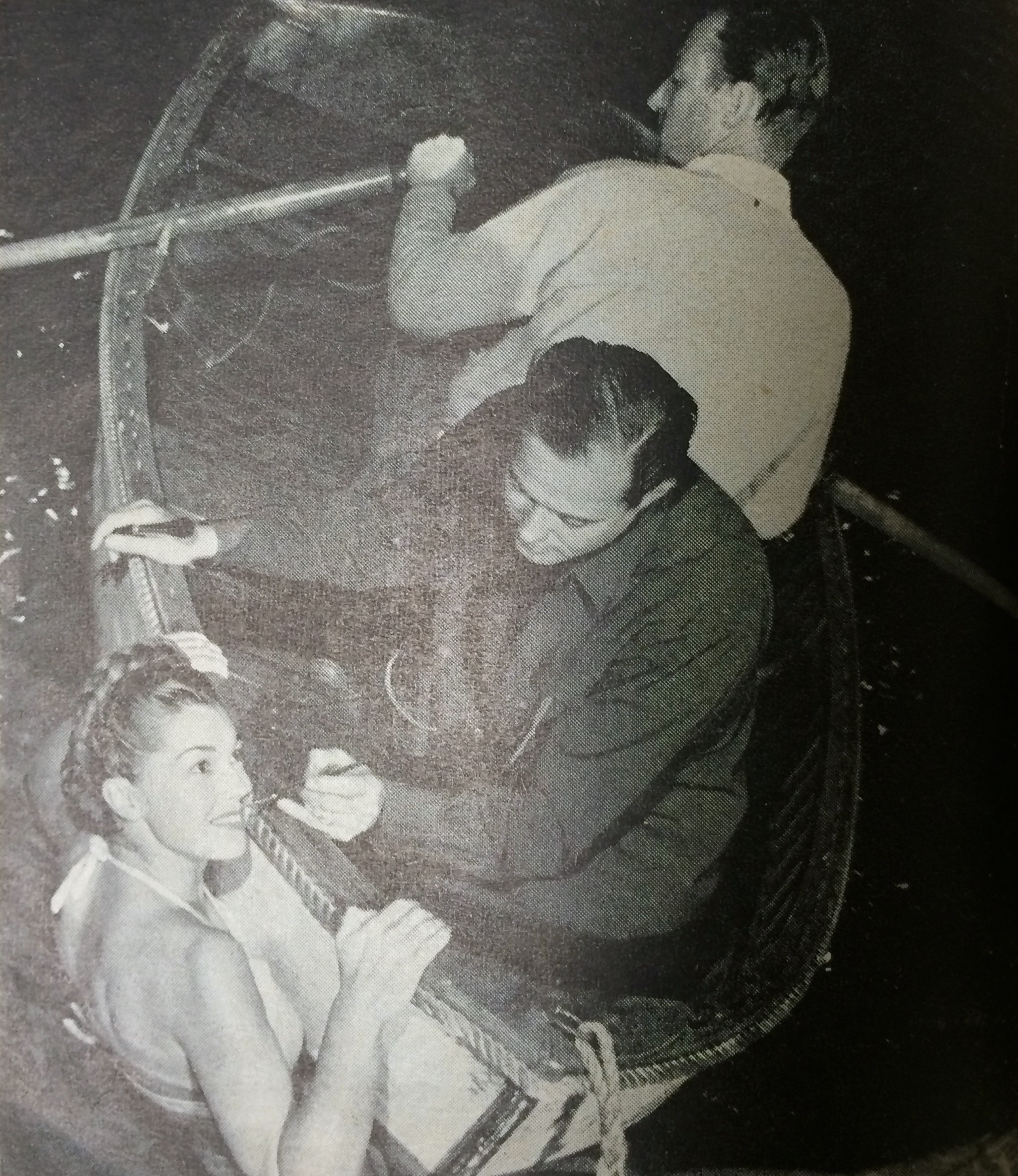
It’s difficult to know if MGM’s makeup wizards used the Aquacade makeup, but they certainly found a way to keep Esther looking perfect in the pool. Since pancake makeup simply washed off in the water, “leaving a cloud of pale beige floating on the surface of the pool,” the makeup artists found a very thick cream foundation that they “slathered” on Esther from head to foot. Then she was dusted with powder and ordered to the shower to set the foundation. All the swimming chorus girls were covered in the gloop and powder, too, and in between takes they would swim over to the edge of the pool where makeup artists were waiting with extra-large powder-puffs nicknamed “Aquapuffs” for touch-ups. Sometimes the makeup artists came to them: one photograph from LIFE magazine’s feature about the filming of Bathing Beauty’s finale shows a smiling Esther clutching the sides of a rowboat in the middle of the tank as an artist reapplies her lipstick. It must have been strange the first time the makeup artist climbed into the boat and was rowed out to the star!
Swimming scenes posed problems for the hairstylists, too. Esther’s hair was left loose in her brief underwater scene with Mickey Rooney in Andy Hardy’s Double Life, but this natural look was deemed too messy for the more demanding choreography with its repeated diving and surfacing.
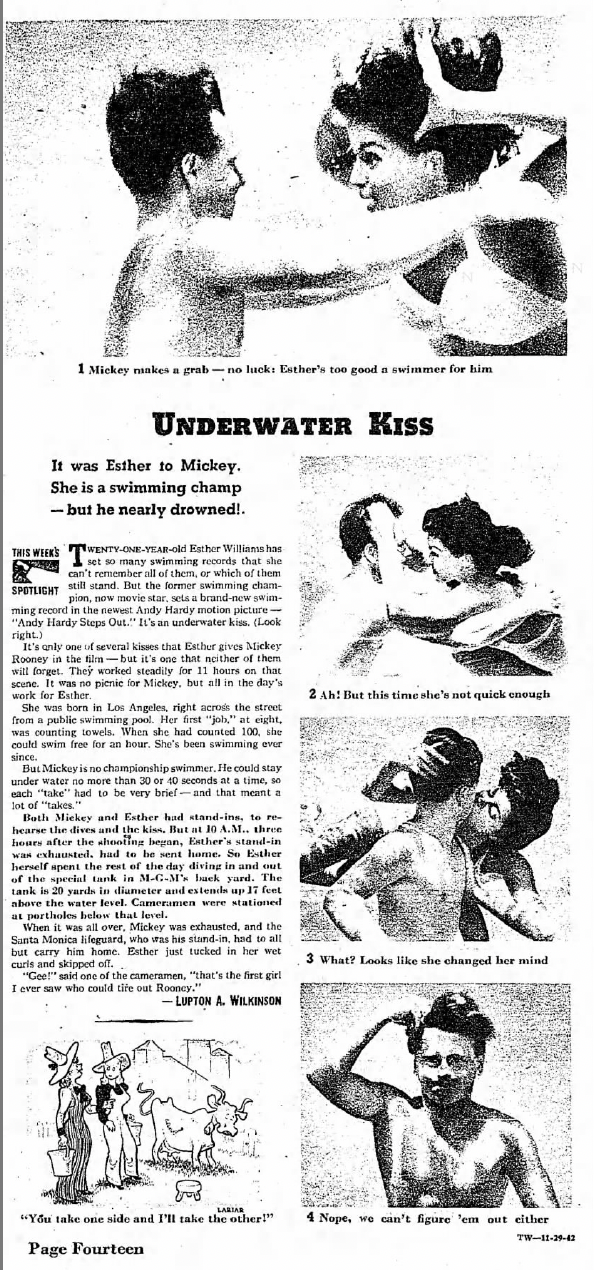
Plus, during the rubber shortage in WWII, “bathing caps” were hard to come by, and it was patriotic to be seen without one. (Even without the complication of rationing, MGM probably would have looked for another option, as a simple swim cap isn’t the most flattering nor glamorous accessory.) Esther needed an attractive hairdo that would stay put and keep her hair out of her face no matter how long she was in the water.
A member of the MGM makeup department named Jack Dawn reportedly solved the problem with an “ancient Chinese recipe” for “hair lacquer.” He created fake coiffures out of clay that he covered with silk and treated with the special lacquer. These hard, waterproof wigs were then worn like swimming caps over the real hair of the swimmers, and could even be lit up for a “translucent effect” with tiny lights placed inside the clay!
This frankly ridiculous story (the swimmers are clearly wearing headdresses covered in shiny, metallic pink and green flower petals) circulated in the country’s newspapers in August and September 1944, but the real solution was much less exotic. The hairstylists hit on a quaintly homemade formula of warm baby oil and Vaseline. The slimy mixture “that looked suitable for lubricating cars” was smeared on Esther’s hair, and the oiled strands were then braided in tiny plaits all over her head. Then thick, fake braids were attached to the real braids with two huge interlocking hairpins that “looked like crowbars—and felt like them, too.”
The Heidi-style updo can be seen in almost every swimming scene in Esther’s films because it looked pretty and it worked: “even when I dove off a high platform, those braids stayed put,” though the crowbar hairpins left welts in Esther’s scalp, and created a permanent indentation down the middle of her head.
For the finale of Bathing Beauty, the braids were adorned with a pearly, sea-shell inspired headdress with strong mermaid vibes, but in other scenes she wears bows, flowers, or ribbons. Sometimes a pretty swimming cap or turban subbed in, but once the hair department hit on the braid style in Bathing Beauty, it became the norm.
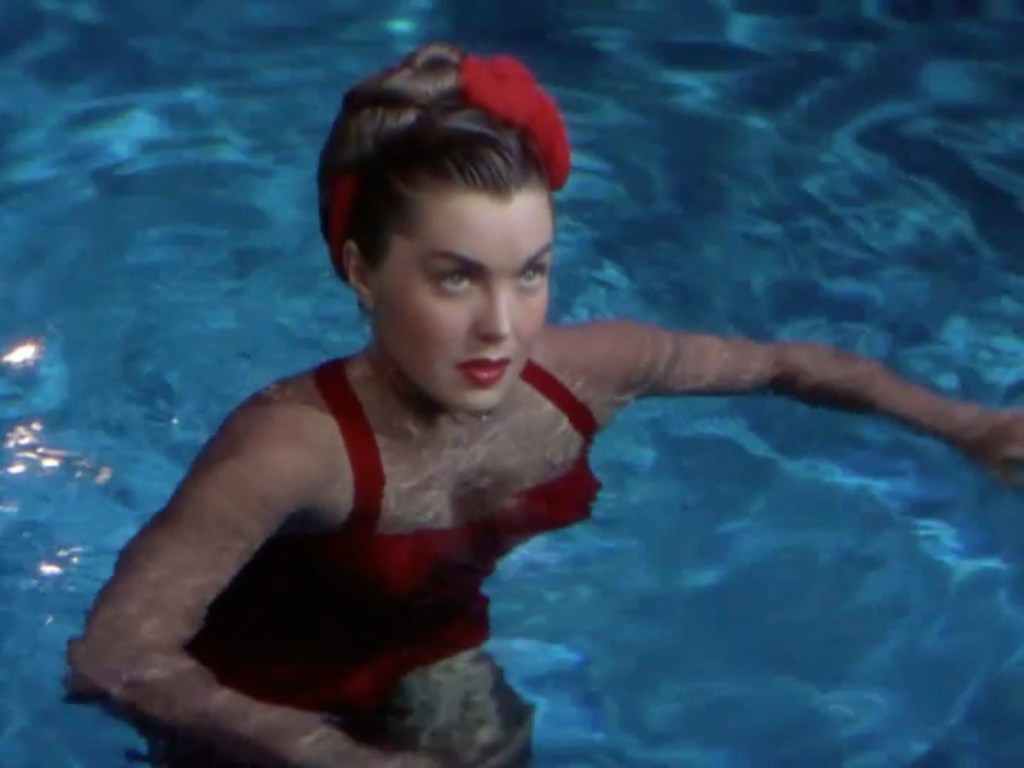
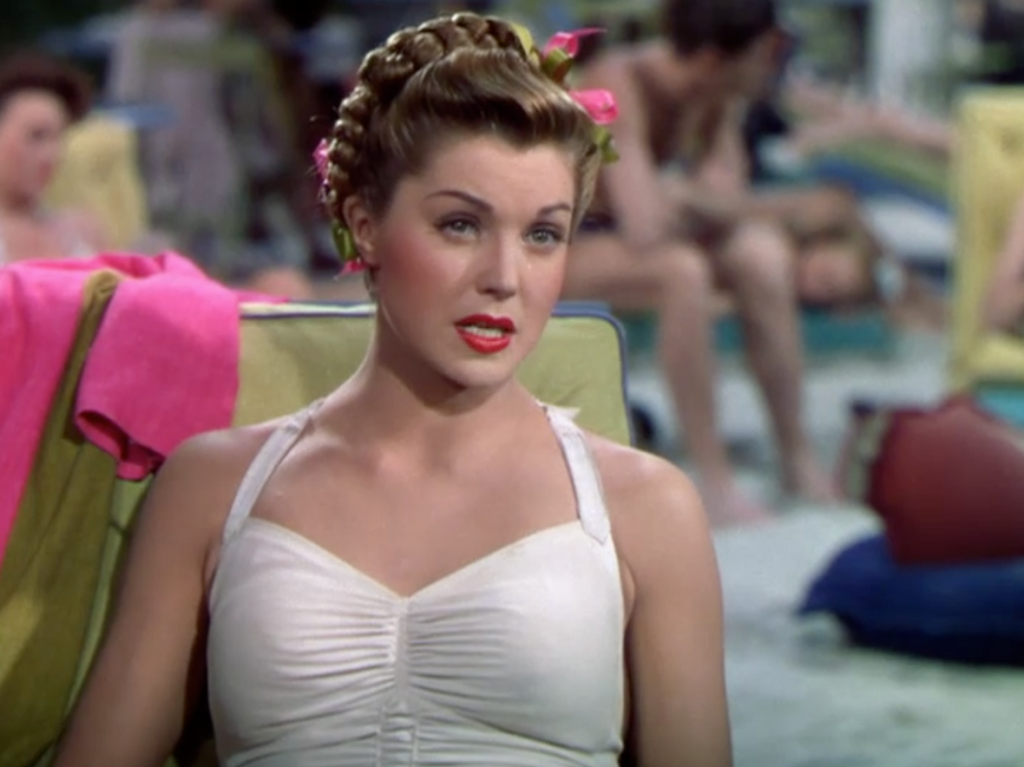
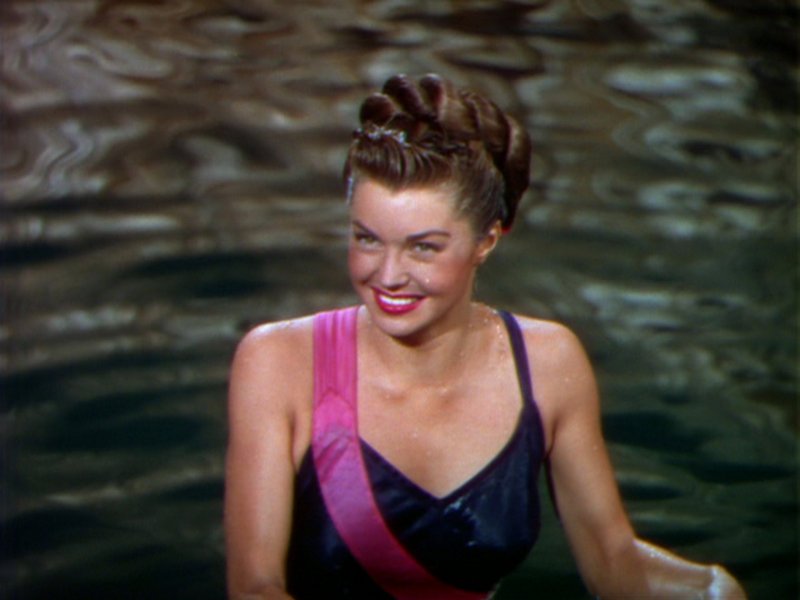
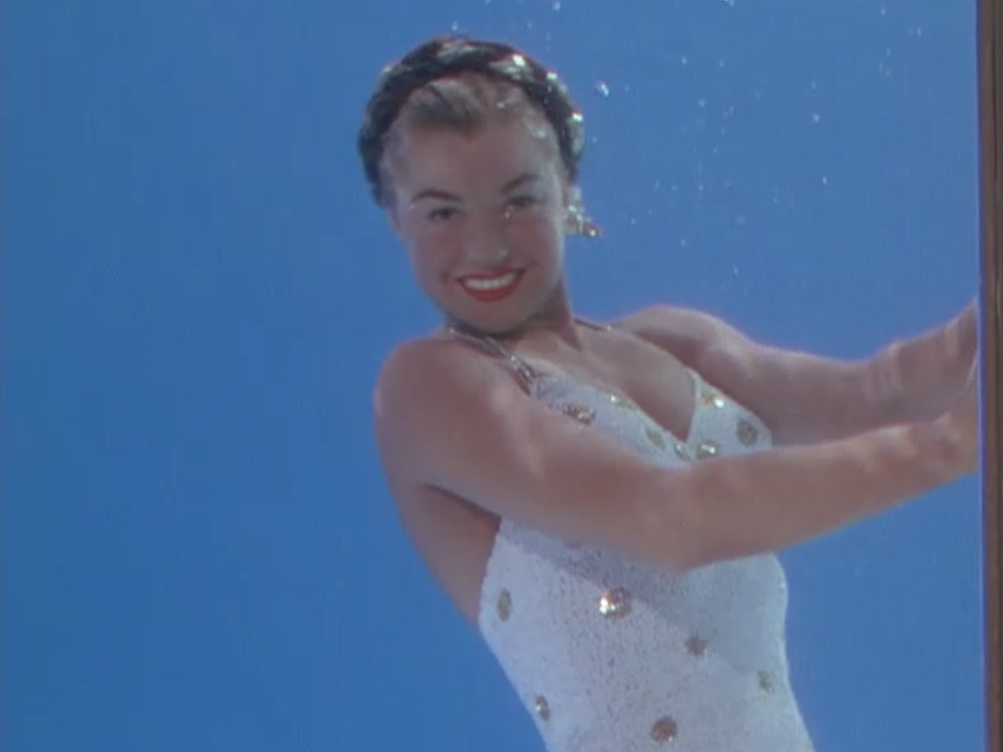

Soon, the makeup and hairstylists were skilled at making Esther and the other swimmers “as waterproof as a mallard” for a day of swimming. It wasn’t an easy nor fast process, but the innovative goops, powders, and braids kept Esther and her chorus looking Mayer-approved and glamorous in those swimming scenes. (Of course, MGM’s full power was also trained on Esther for the dry scenes, and sometimes even in the finale’s color palette of hot pink and green…but more on that later.)

Thanks for reading, and stay tuned for the next excerpt of The Mermaid and Me for more on Bathing Beauty and the next steps for its swimming star!
 The Blonde at the Film