Champion in Training
This is the third excerpt from my book, The Mermaid and Me. You can find the first two here: The Mermaid and Me and The Baby Mermaid.
Champion in Training
Esther’s swimming career started as a cute publicity stunt, but it quickly grew into her favorite activity. Esther began spending most of her time at the pool, which was about a block from her house, and during the summer she got a job counting towels to cover the five-cent fee to swim. The job also allowed her access to the pool during lunchtime when the lifeguards worked out. The young men noticed Esther’s raw talent and her love for the water, and they adopted Esther as a little mascot. They taught the eager kid the different strokes, and once she’d mastered the basics they moved onto the finer details of competitive swimming like breathing and pacing.
Esther was clearly a gifted swimmer who was also stronger than most girls her age. She was able to handle anything the lifeguards threw at her, and after a summer under their tutelage, nine-year-old Esther could keep up with the boys during their lunchtime workouts. Significantly, these lifeguards didn’t view Esther as “just a girl;” for instance, they taught her the butterfly stroke, which at the time was only performed by men. She would later use this unorthodox technique to win races on the national stage. The young Mermaid had gone from mascot to peer in a flash.
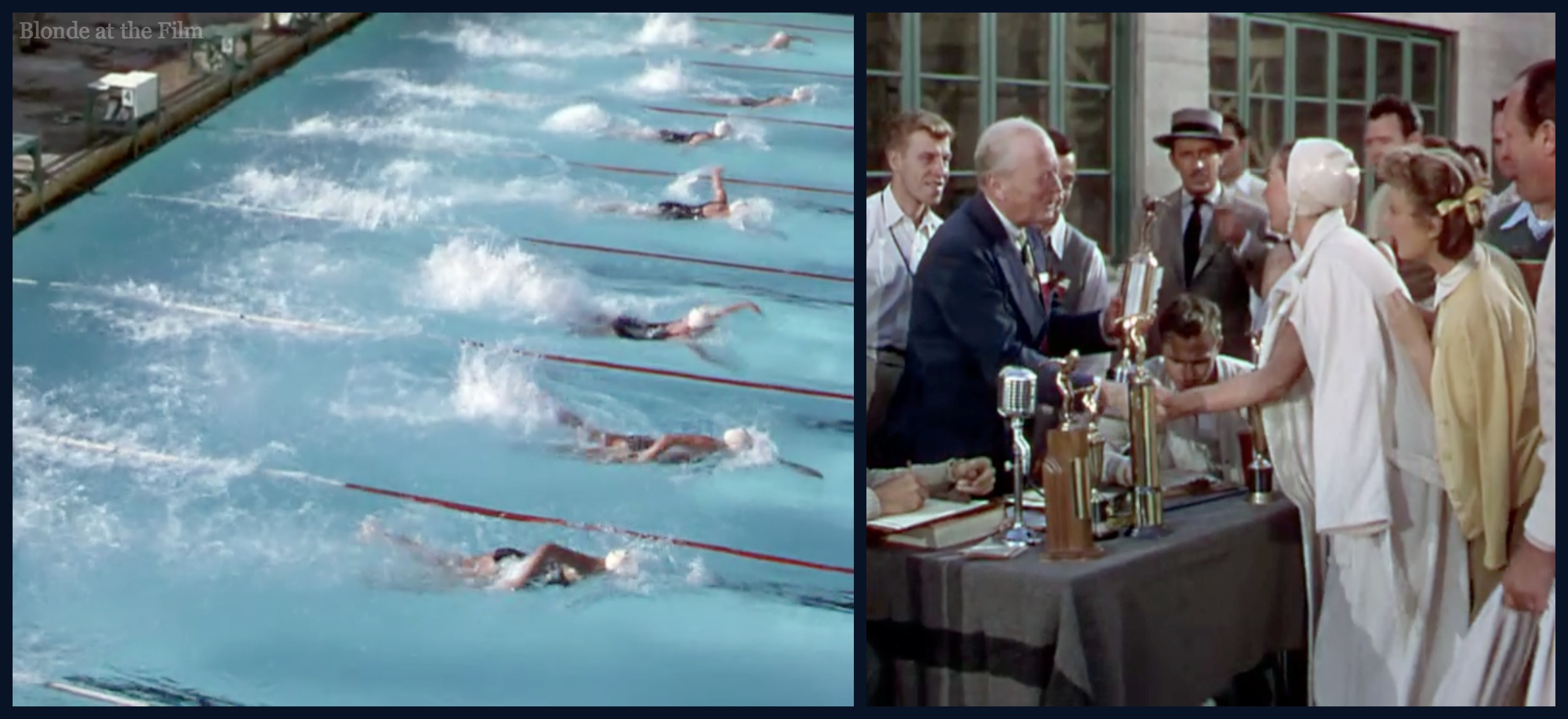
Esther began competing in swim meets early on, and in 1932 she won her first big race, the fifty-meter freestyle at the Metropolitan Meet. This was a huge swim meet that drew kids from all over Los Angeles and also attracted coaches from the best teams around. Aileen Allen, a former Olympic diver and the women’s swimming and diving coach at the prestigious Los Angeles Athletic Club, noticed eleven-year-old Esther, and she encouraged her to try out for the elite organization. The L.A.A.C. was a perennial powerhouse that churned out Olympians. It was housed in a beautiful Beaux-Arts style building on Seventh and Olive in downtown LA that had been built for the club in 1912. The swimming facility was on the 7th floor, making it the first building in southern California to have a pool on an upper floor. The L.A.A.C. seemed like another world from the Depression-stricken neighborhood where Esther grew up.
The Mermaid would join the elite L.A.A.C. in 1937, but until then she kept training, getting faster and stronger all the time. She was happy in the water.
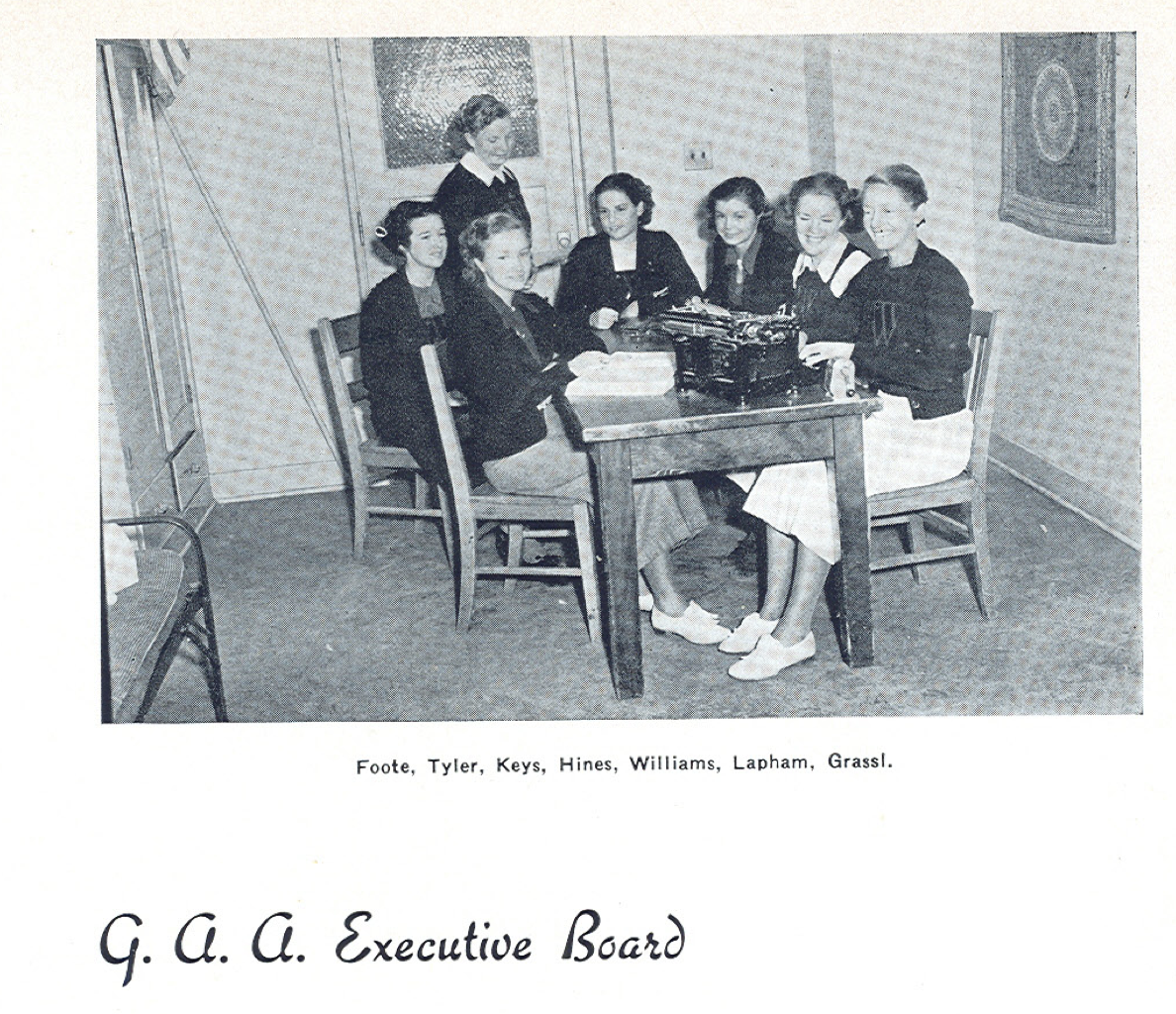
She attended Washington High School where she was active in clubs and student government. During her sophomore year, Esther became a member of the Commerce Honor Society, and she served as the summer secretary-treasurer of the Girls Athletic Association which promoted female athletes and sports at the school. (Four decades before Title IX! And I can’t think of a better ambassador for female athletes than Miss Esther.) She was elected to the summer Student Body Cabinet after her sophomore year, and served as the secretary of the Girls’ League and a member of the Tri-Y Women’s Club, the Scholarship Society, and the Commerce Honor Society in her junior year.
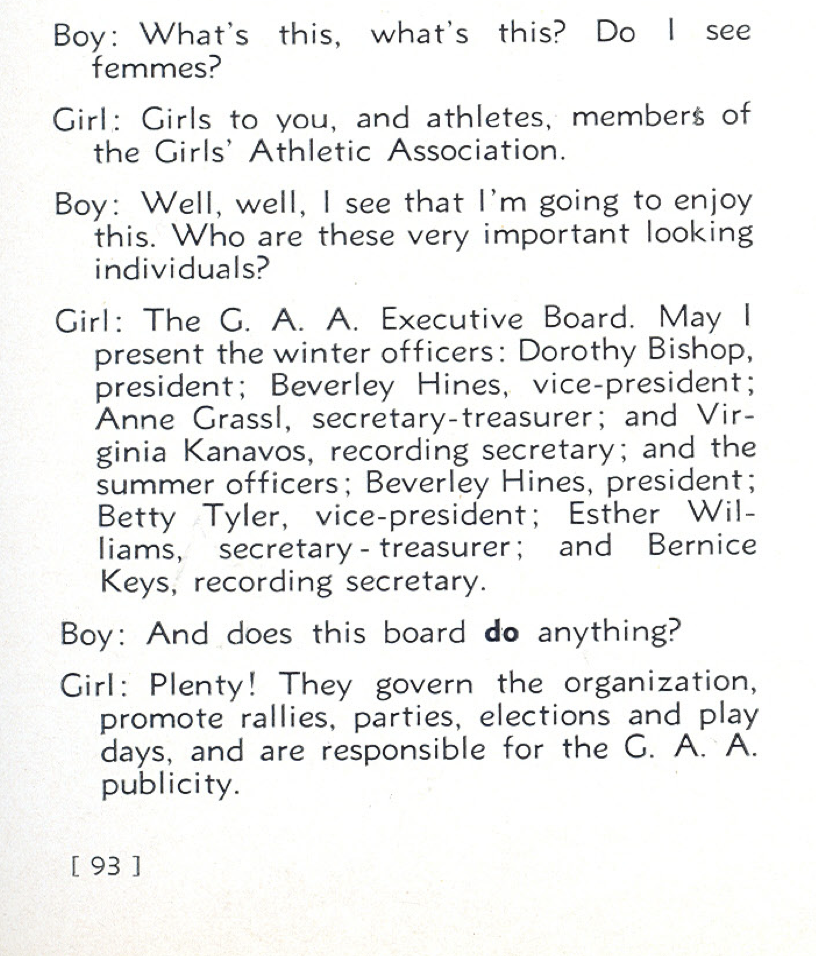
The yearbook photos from her time at Washington High show a sturdy girl with a bright smile and a round face. Her dark, thick hair is styled in a shoulder-length bob pinned back in soft curls, nothing fancy nor high maintenance for this athletic young woman who spent most of her time wearing a swim cap. She’s dressed in plain skirts and collared shirts in the late 1930s schoolgirl style. Her head tilts becomingly to her left in almost all of these pictures, and she sports a shyly confident smile on her pretty face. MGM was wise enough not to mess with her All-American look when she became a starlet.
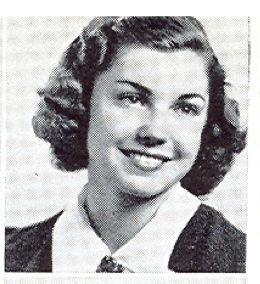
These photos of a high-school Mermaid don’t scream “future movie star,” but neither do they squeak “quiet wallflower.” She was clearly a well-liked kid who enjoyed being involved at school, though she didn’t particularly excel in the classroom. Suprisingly, given her later career, Esther didn’t participate in drama or public speaking in high school, and apart from school plays in elementary school, (she vaguely remembered being a rose in a May Day production in first grade) she kept mostly to swimming and student government. She even joined the Swimming Club her sophomore year, though that seems unfair to the other girls. The club picture is amusing in hindsight: it shows Esther in a line of seven girls frozen on the edge of the pool in a racing dive pose. Her arms shoot behind her, straight and strong; her head is lifted. She stares at the finish line across the pool while her fellow club members are captured mid-giggle with bowlegged stances and flailing arms.
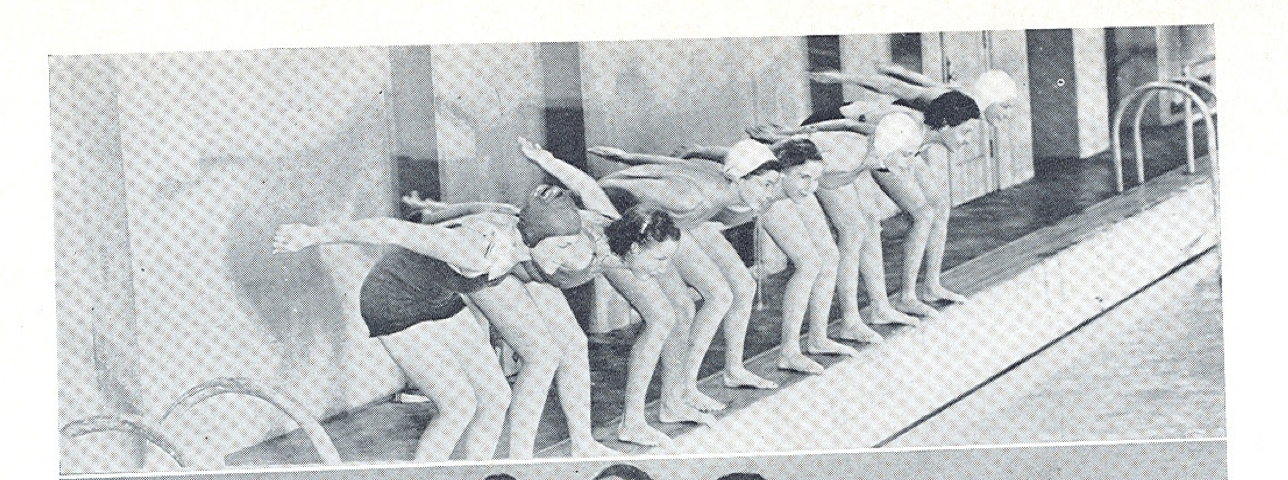
After all, the Mermaid had earned a coveted spot on the Los Angeles Athletic Club swim team in 1937, and she excelled with the help of great coaches and the wonderful facility. She loved competing, loved winning, and loved feeling strong and skilled. And she loved the camaraderie of her teammates and the travel—she’d never been far from home before, but suddenly she was participating in swim meets across the region and the country.
Esther first appeared as a member of the L.A.A.C. swim team in November for the inaugural indoor meet of the 1937 season. She was barely sixteen at her first meet, but the teenager showed extraordinary poise and promise as she began swimming in elite competitions. By February 1938, the relative newcomer was becoming her teammate Virginia Hopkins’ chief rival in the freestyle sprint events. Hopkins was the defending national champion, but Esther began inching closer throughout 1938. Esther and her teammates were some of the best swimmers in the country, and records began falling whenever they competed. For example, in April 1938 at the National AAU Championships at the L.A.A.C.’s pool, Esther came in third behind Hopkins in the 220-yard freestyle event, and the winner, Halina Tomski, set a new national record in her dash to beat them.
In June, Hopkins and Esther set a new world record in the 50-meter freestyle in an exhibition race in front of fifteen-thousand spectators at the Olympic Stadium in Los Angeles, host of the 1932 Games. The record had stood since 1926, but the teenaged Esther and Hopkins broke it by two-tenths of a second in their mad dash across the pool.
Esther kept chasing Hopkins all summer. In mid-July at the Senior National AAU swim meet in Santa Barbara, which was her first National Championship meet, she came in third in the 100-meter freestyle, again failing to catch Hopkins. But that was one of the last times that Esther lost. About a week later, she beat Hopkins in that event at the Mile-High Diamond Medal meet at Lake Arrowhead in the San Bernardino Mountains.
But she was just getting started.
In February 1939, Esther earned the title “fleet Los Angeles Athletic Club mermaid” after she won the 100-yard freestyle at the Junior National Championships held at the L.A.A.C. (Although Clark Gable would later be given credit for christening Esther a “mermaid” at MGM, she had earned the moniker years before in the sports pages.)
About a month after the Junior National Championships, Esther put on an astonishing performance at the Southern Pacific A.A.U. event in Pasadena. She won every event she entered: bringing home victories in the 150-yard individual relay and the 100-yard breaststroke, and winning the 150-yard medley relay with her teammates Virginia Hopkins and Diana Cannon. Esther also set an unofficial individual relay record in her preliminary heat, and she left the meet as the only double winner in individual events and the only record-setter. Her performance helped the L.A.A.C. to a commanding victory, beating the second-place club 62-13.

About ten days after dominating the Pasadena pool, Esther swam the breaststroke leg in the 300-yard medley relay at the 1939 Senior National Championships. But instead of swimming the typical breaststroke, Esther used the butterfly stroke that she had learned as a kid from the lifeguards at her neighborhood pool. The butterfly was slowly becoming less of a male-only domain, and at the time, one could swim the butterfly in breaststroke events. But Esther was one of the few who had mastered it—most women were still using the traditional breaststroke. It wasn’t until 1952 that the butterfly would become a separate event (hence the 300-meter swim instead of the 400 modern day medley.) Esther’s team won the relay event and set a national record.
That spring, Esther’s streak continued with titles at the National Intercollegiate Telegraphic Meet, the Far Western Indoor Championships in Seattle, and the outdoor nationals, where she had the fastest 200-meter swim in the relay. In April 1939, she demolished the national record for the 100-meter breaststroke, shaving off over one second from the previously held time. And the L.A.A.C. relay team continued their domination. They were difficult to beat with Esther swimming breaststroke/butterfly and Virginia Hopkins crushing the freestyle leg.
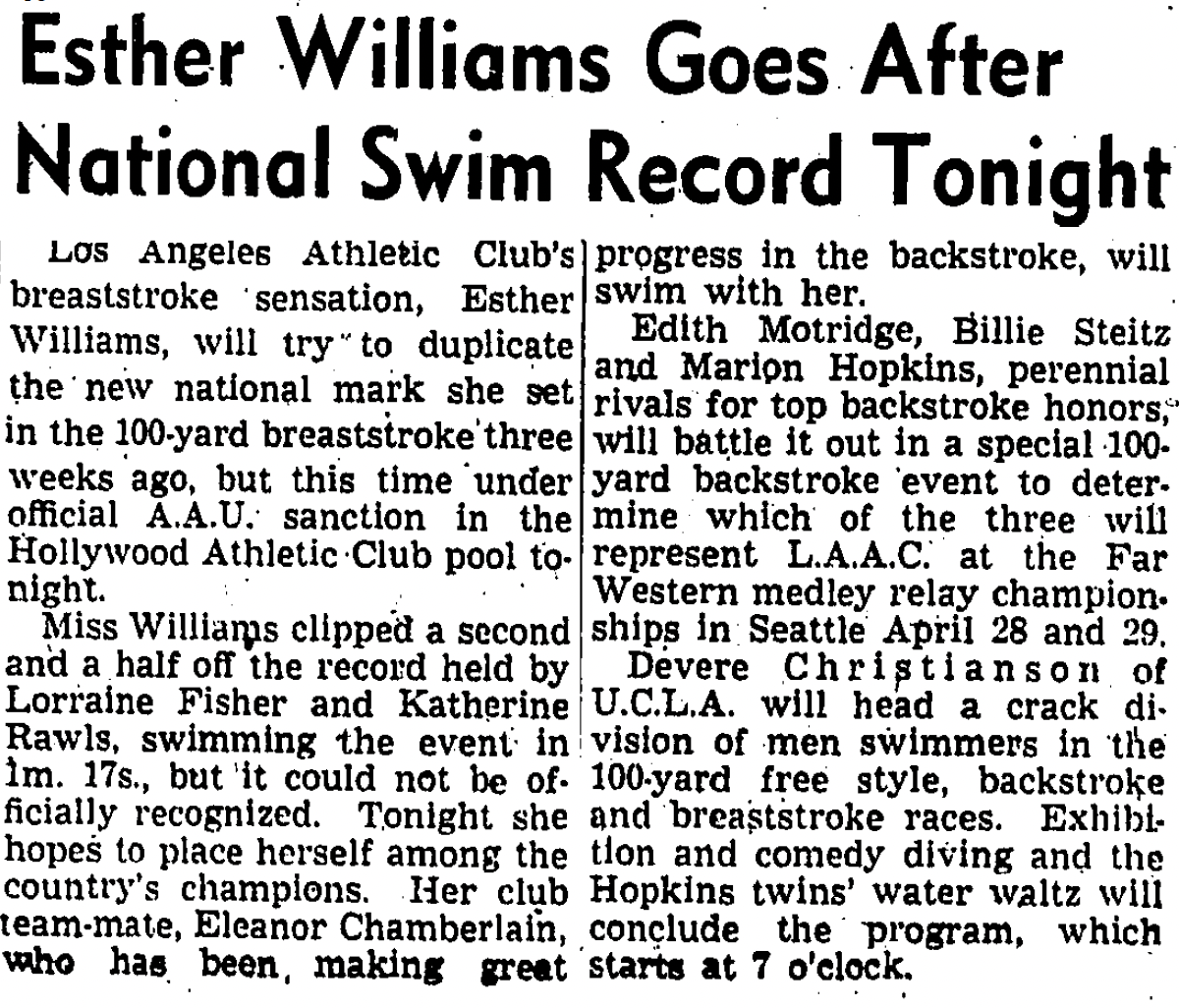
In May, Esther set a national 50-yard breaststroke record, then bettered it in June at the Southern California Open Swimming and Diving Meet at Olympic Stadium. She also captured the 100-yard freestyle and the 300-yard individual medley prizes. Her teammate, 26-year-old Edith Motridge, who’d come in 4th in the 100-meter backstroke at the 1936 Olympic Games, set records in the backstroke at that meet, and she soon joined Esther and Hopkins to make a relay dream team.
At the same meet the previous June, Esther had come in second to Virginia though they’d both broken the 50-meter freestyle record. Just a year later, Esther was dominating three individual events and the relay, and had several national records to her name. Her extraordinary rise from gifted local talent to national star had been swift, and it was far from over.
Thanks for reading! Look for more excerpts from The Mermaid and Me soon.
Categories: History, Uncategorized
 The Blonde at the Film
Amazing talent. Did her family support her training and travel commitments?
Yes! I think they were very proud of her, and also the swim club took care of everything. It helps when you are a superstar!